
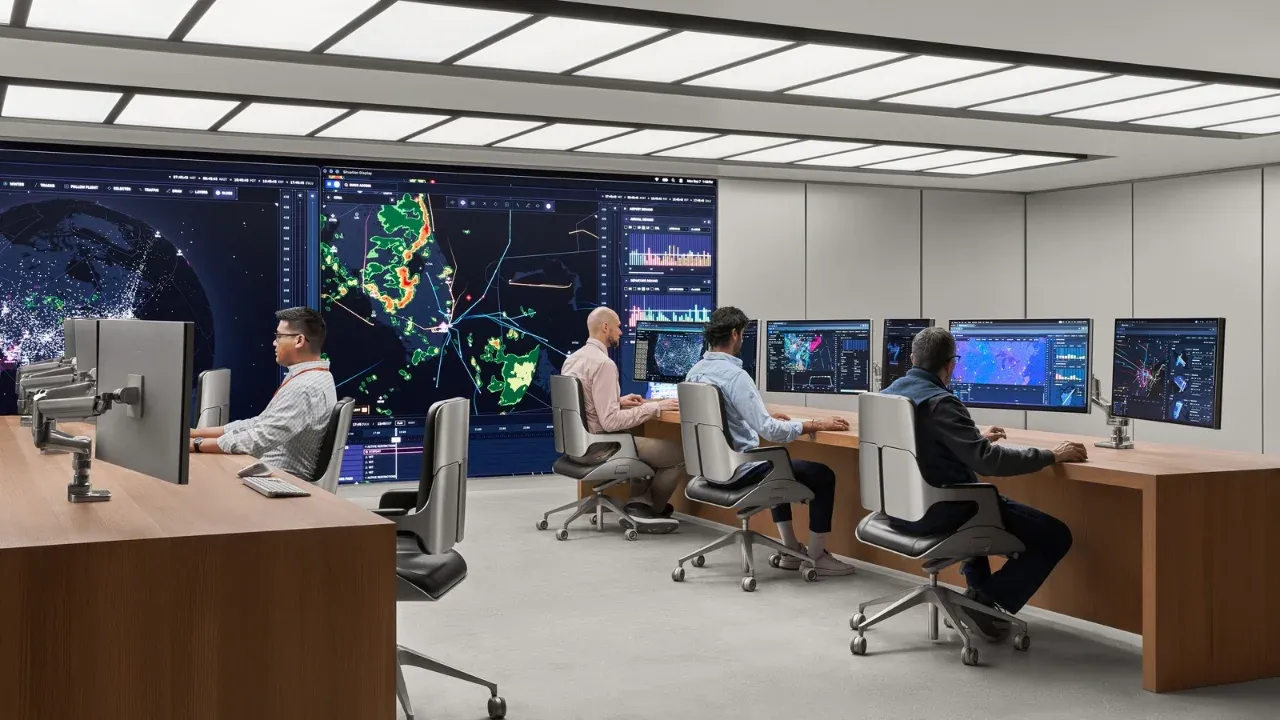
The push to automate the management of physical assets is gaining significant capital momentum as ASI secures $325 million in Series C financing at a $3 billion valuation. Led by Spark Capital, the funding round includes participation from affiliates of Citadel Securities, Meritech Capital, Craft Ventures, Energy Impact Partners, and Andreessen Horowitz (a16z). This investment targets the expansion of AI systems designed to orchestrate critical infrastructure, moving beyond text-based generative models toward reasoning systems capable of managing complex, real-world environments. ASI is positioning its technology as an automated nervous system for sectors where human operators currently face the limits of manual, reactive monitoring.
ASI Series C Funding and Market Positioning
The $325 million infusion is intended to accelerate the deployment of ASI’s frontier AI across the energy, logistics, and tactical edge sectors. Headquartered in Boston, the company plans to use the capital to expand its research and engineering teams. ASI differentiates itself by focusing on AI that manages physical assets—such as aircraft, maritime vessels, or electrical grids—rather than purely digital or linguistic tasks. The company claims its systems utilize continuous forward simulations and multidimensional monitoring to model potential outcomes hours, days, or even weeks in advance. By balancing deterministic and probabilistic modeling, ASI aims to shift critical infrastructure management from reactive triage to predictive orchestration.
This financial milestone follows significant contract wins that the company highlights as evidence of its ability to handle high-stakes operations. Notably, ASI secured an $875 million program of record from the U.S. Department of Transportation and the Federal Aviation Administration to modernize the National Airspace System. Additionally, the U.S. Army recently awarded the company a $99 million contract to scale its technology within modernized command and control efforts, including the Next Generation Command and Control (NGC2) program. These large-scale federal agreements, combined with commercial adoption, suggest ASI is attempting to establish itself as a foundational layer for sovereign infrastructure.
Scaling AI for Grid Reliability and Energy Planning
For the energy sector, ASI is positioning its technology as a solution to the increasing complexity of modern electrical grids. As electricity demand rises, utilities face the dual challenge of upgrading aging infrastructure while maintaining high reliability levels. ASI has already entered into a partnership with National Grid, a utility serving over 20 million people in the Northeast U.S., to deploy its technology for electric grid planning and operations. The company suggests its platform can assist utilities in anticipating disruptions, such as storm responses, and optimizing long-term investment and planning strategies.
The strategic value for energy operators lies in the transition from manual oversight to automated foresight. Current grid management often relies on human operators tracking limited data in real-time, which can be insufficient during rapid shifts in load or supply. ASI’s approach involves modeling interconnected assets to provide a comprehensive view of future states. By simulating various scenarios, the technology aims to allow operators to identify and mitigate potential failures before they manifest. This capability is particularly relevant as grid operators integrate more volatile renewable sources and manage higher demand loads, necessitating more sophisticated, predictive decision-making tools to ensure system stability and prevent widespread outages.
Key Takeaways
- ASI raised $325 million in Series C funding at a $3 billion valuation, led by Spark Capital.
- The company holds an $875 million program of record with the FAA and DOT to modernize the National Airspace System.
- National Grid has partnered with ASI to utilize its AI for electric grid planning and operational management.
EnergyInsyte's Take
In our view, ASI’s massive Series C valuation reflects a growing investor appetite for "physical AI"—technology that moves beyond chatbots to manage the tangible assets that underpin national security and energy stability. While much of the AI hype has centered on software and content, ASI is targeting the high-barrier-to-entry world of critical infrastructure. Their partnership with National Grid is a significant signal; it suggests that utilities are looking for more than just incremental digital upgrades—they are seeking predictive orchestration to manage the volatility of the modern grid. However, the success of this model depends on whether these complex, multidimensional simulations can maintain the extreme reliability required by mission-critical sectors. If ASI can successfully bridge the gap between probabilistic AI modeling and the deterministic requirements of grid operations, they may well become a standard component of the next generation of energy infrastructure.
Questions & Answers
How does ASI’s technology differ from standard generative AI models?
Unlike generative AI focused on text and language, ASI develops reasoning systems designed to manage and control physical assets. The technology uses continuous forward simulations and multidimensional monitoring to model future operational states, aiming to provide predictive foresight for complex systems like the energy grid or aviation networks.
What specific energy sector applications has ASI demonstrated?
ASI has partnered with National Grid to deploy its technology for electric grid planning and operations. The goal of this deployment is to help the utility manage grid complexity, respond to disruptions such as storms, and optimize long-term planning and investment strategies.
What scale of federal contracts has ASI secured to date?
ASI has secured an $875 million program of record from the U.S. Department of Transportation and the Federal Aviation Administration for National Airspace System modernization. Additionally, the U.S. Army awarded the company a $99 million contract for its Next Generation Command and Control (NGC2) program.
Which major commercial entities are currently using ASI’s platforms?
In the commercial sector, ASI’s systems are utilized by major airlines, including Delta Air Lines, Alaska Airlines, and United Airlines, as well as the utility provider National Grid.
Source: ASI