
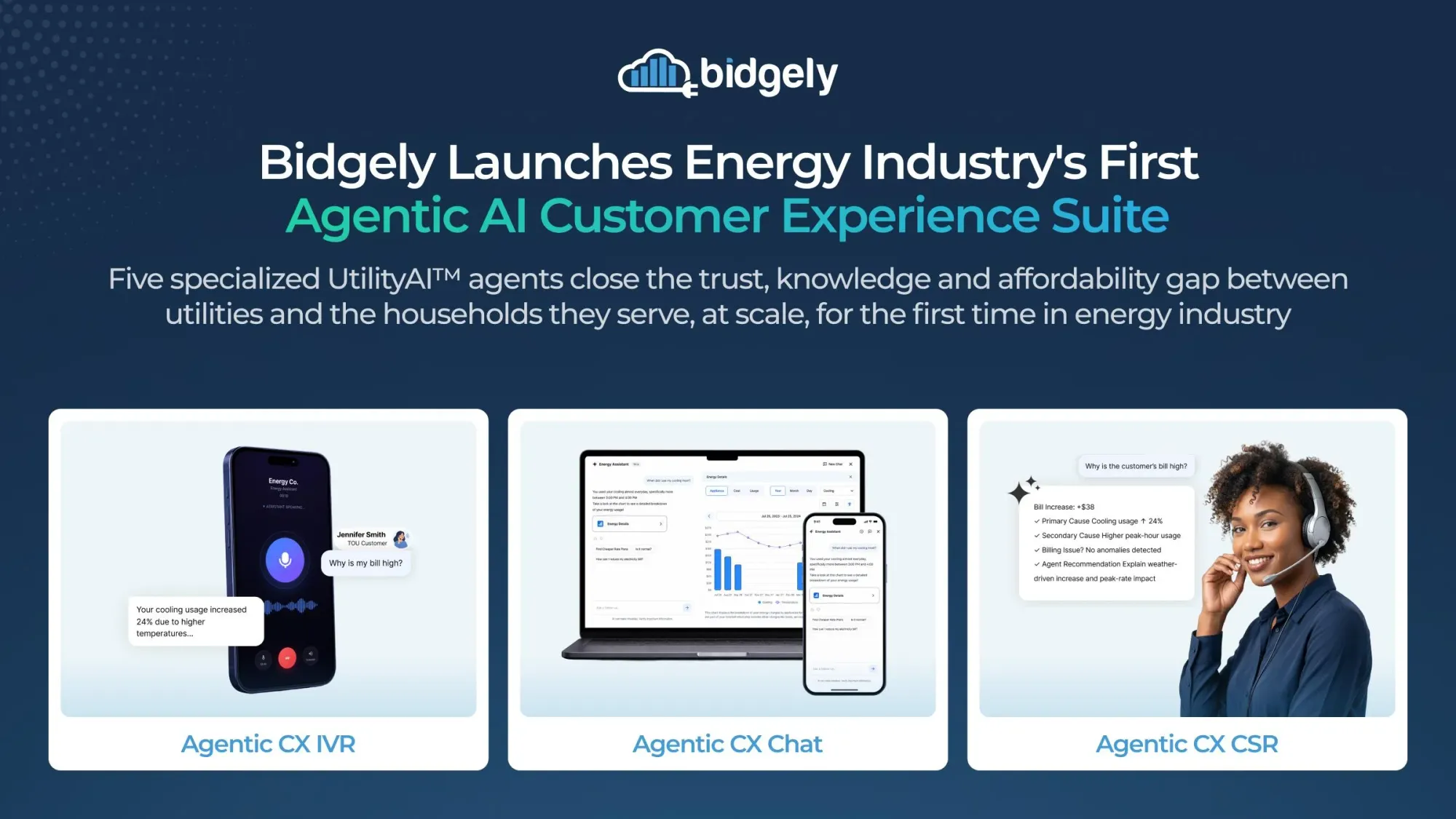
Utilities are increasingly struggling to manage the operational friction caused by high-bill inquiries, rising cost-to-serve metrics, and complex regulatory mandates. To address these pressures, Bidgely has announced the launch of Agentic CX, an AI-driven customer experience suite designed to bridge the information gap between energy providers and households. Rather than relying on generic chatbots, the company is positioning this suite as a specialized tool that utilizes appliance-level data to provide granular explanations for usage fluctuations. By deploying five distinct UtilityAI™ agents, the company aims to transform standard customer service interactions into data-driven consultations regarding rate plans, solar payoffs, and electric vehicle impacts.
Bidgely Deploys Five Specialized UtilityAI™ Agents
The Agentic CX suite is built upon more than a decade of behind-the-meter data, aiming to replace legacy estimates with specific, appliance-level insights. Bidgely has structured the technology around five specialized agents: the High Bill Analyzer, Home Energy Audit, What-If Solar, What-If EV, and Best Rate. These agents are designed to function across three primary engagement channels: chat, interactive voice response (IVR), and customer service representative (CSR) support.
The High Bill Analyzer is intended to pinpoint the exact appliances and habits driving bill spikes, while the What-If Solar and What-If EV agents calculate realistic payoffs and bill impacts based on historic usage patterns. To assist with cost management, the Best Rate agent evaluates individual household savings through rate structure analysis. According to the company, these tools have previously helped utilities achieve a 50 percent reduction in high-bill calls and a 30 percent decrease in average call handle time. Furthermore, Bidgely claims that its deployments have seen CSR churn reduce by more than 15 percent and CSAT scores reach between 80 and 85 percent, contributing to significant lifts in JD Power ratings.
Integrating Agentic AI into Existing Utility Infrastructure
A core component of the Agentic CX rollout is its ability to integrate with current enterprise frameworks without requiring a total infrastructure overhaul. Bidgely states that the suite is compatible with existing Contact Center as a Service (CCaaS) and enterprise AI platforms, while meeting industry standards for data privacy and governance. The "Prevent" function utilizes an energy assistant compatible with ChatGPT to answer complex questions via chat, potentially reducing the need for live escalations.
The "Contain" function targets the IVR channel, integrating with platforms such as NICE, Genesys, AWS Connect, and Poly.ai to replace traditional menu-based routing with natural language dialogue. Finally, the "Accelerate" function acts as a real-time co-pilot for CSRs. This tool is designed to surface root-cause usage drivers and automated rate plan analyses the moment a call connects, which the company suggests can elevate the expertise of both new and veteran representatives. By grounding these interactions in patented appliance-level insights rather than canned responses, Bidgely is attempting to provide a level of personalization that standard CX offerings typically lack.
Key Takeaways
- Bidgely’s Agentic CX suite utilizes five specialized agents to provide appliance-level energy insights across chat, IVR, and CSR channels.
- The technology aims to address operational pressures by targeting a 50 percent reduction in high-bill calls and a 30 percent decrease in average call handle time.
- The suite integrates with existing CCaaS and enterprise AI platforms, including NICE, Genesys, AWS Connect, and Poly.ai.
EnergyInsyte's Take
In our view, Bidgely’s move toward "agentic" AI signals a critical shift in how utilities must manage the increasingly complex relationship between grid demand and consumer behavior. As distributed energy resources like EVs and residential solar become more prevalent, the traditional "bill-and-wait" model of customer communication is becoming a liability for call center operations. By attempting to automate the "why" behind energy usage through appliance-level granularity, Bidgely is testing whether utilities can successfully offload high-volume, low-value inquiries to intelligent, data-grounded agents. If these claims regarding a 50 percent reduction in high-bill calls hold true at scale, it represents a significant opportunity for utilities to reallocate human capital toward more complex grid management and infrastructure tasks, rather than repetitive billing disputes.
Questions & Answers
How does Agentic CX differ from standard utility chatbots?
Unlike generic chatbots that use canned responses, Agentic CX is grounded in patented, appliance-level insights derived from over a decade of behind-the-meter data. This allows the system to explain specific usage drivers and provide personalized recommendations for rate plans and energy efficiency.
Which existing communication platforms can this suite integrate with?
The suite is designed to integrate with existing Contact Center as a Service (CCaaS) and enterprise AI platforms. Specifically, the IVR component is built to work with platforms such as NICE, Genesys, AWS Connect, and Poly.ai.
What specific operational metrics is Bidgely targeting for utilities?
Bidgely highlights several key performance improvements, including a potential 50 percent reduction in high-bill calls, a 30 percent decrease in average call handle time, and a 15 percent or greater reduction in CSR churn.
How does the "Accelerate" feature assist customer service representatives?
The Agentic CX CSR co-pilot surfaces root-cause usage drivers and performs automated rate plan analyses in real-time the moment a call is connected, providing the representative with actionable answers to assist the customer immediately.
Source: Bidgely