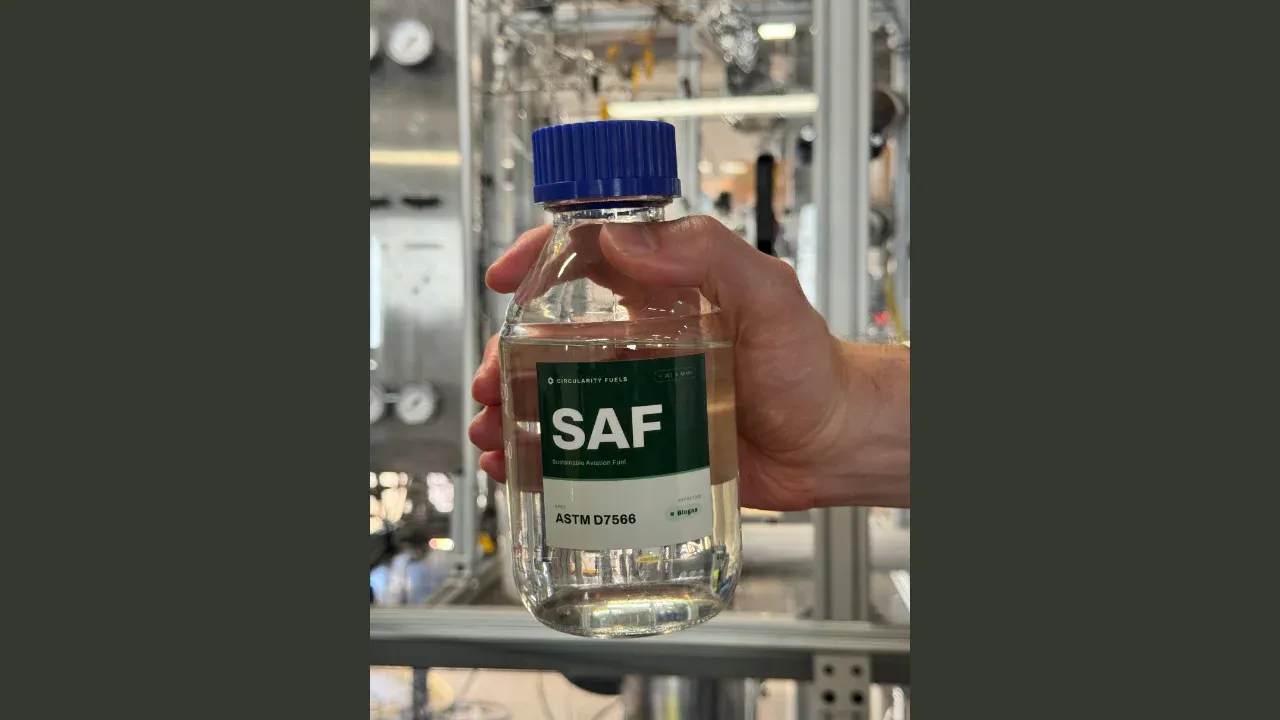
Circularity Fuels has completed the first end-to-end conversion of raw agricultural biogas into sustainable aviation fuel (SAF) during a six-month pilot in California. The system converts manure-derived biogas directly into drop-in jet fuel, offering a distributed production model that aims to lower capital costs compared to centralized plants.
Circularity Fuels Modular Reactor System and Pilot Results
The pilot operated for thousands of hours using raw biogas—composed of approximately 65% methane and 35% CO₂—drawn from a manure digester at a dairy farm with more than 5,000 head near Madera, California. The technology utilizes a two-reactor stack consisting of an electrified Ouro bi-reforming reactor and a compact Aion Fischer-Tropsch synthesis reactor. Both components are modular, skid-mounted units designed for the small, distributed scales typical of biogas production.
The Ouro reactor achieved over 98% methane conversion and more than 90% CO₂ conversion in a single electrified step. This process addresses the high CO₂ content of biogas, which the company identified as a primary historical barrier to economical conversion. The resulting fuel meets ASTM D7566 Annex A1 (FT-SPK) specifications and can be blended up to 50% with conventional Jet-A for use in current commercial aircraft.
Economics of Biogas-Derived SAF and Capital Costs
Circularity Fuels projects commercial capital costs at less than $100,000 per barrel-per-day of installed capacity. According to the company, this is approximately one-fifth of the capital cost of SAF plants currently under construction in Europe. This reduction in capital expenditure is intended to make biogas-derived SAF cost-competitive with fossil jet fuel.
The company's economic model leverages the fact that agricultural biogas is a low-cost feedstock that is frequently vented to the atmosphere. By monetizing methane on-site, operators avoid the costs associated with carbon dioxide removal and pipeline infrastructure. The fuel is positioned to qualify for federal and state incentives, including the EPA’s Renewable Fuel Standard and California’s Low Carbon Fuel Standard (LCFS) carbon-negative pathway.
Carbon Intensity and Environmental Modeling
Internal life-cycle modeling based on California’s regulatory framework assigns the fuel a carbon intensity of -350.7 gCO₂e/MJ. This net carbon-negative score is attributed to the consumption of methane that would otherwise be vented by the dairy. The company states that the avoided methane emissions outweigh the emissions produced during the fuel's production and combustion, making each gallon equivalent to removing roughly 100 pounds of CO₂e from the atmosphere.
Commercial Deployment Timeline and Global Targets
Following the field validation of its integrated technology stack, Circularity Fuels is preparing for commercial-scale deployment. The company expects to break ground on its first commercial site in 2027. Target markets for these deployments include agricultural biogas resources across the United States, Europe, and Latin America.
Key Takeaways
- The pilot produced ASTM D7566 Annex A1 compliant jet fuel using a modular system with a projected capital cost of <$100,000 per barrel-per-day of installed capacity.
- The Ouro reactor achieved more than 98% methane conversion and more than 90% CO₂ conversion from raw biogas.
- The company plans to break ground on its first commercial-scale deployment in 2027, targeting the U.S., Europe, and Latin America.
EnergyInsyte's Take
The ability to process raw biogas on-site without expensive CO₂ removal equipment could significantly lower the entry barrier for distributed SAF production. Executives should monitor whether the projected one-fifth capital cost advantage holds during the 2027 commercial scale-up. The primary uncertainty remains whether these modular units can maintain efficiency and cost-parity across diverse global regulatory frameworks outside of California's LCFS.
Source: Businesswire