Power Integrations (NASDAQ: POWI) announced two new ultra‑compact auxiliary power supply (PSU) reference designs—15 W and 35 W—tailored for NVIDIA’s Kyber 800 VDC liquid‑cooled, blade‑rack AI data centers. The designs promise up to 30 % board‑space savings and a similar reduction in bill‑of‑materials (BOM) count, while maintaining at least 88 % efficiency, a point of interest for utilities and data‑center operators focused on density and reliability.
New Ultra‑Slim Reference Designs for NVIDIA Kyber
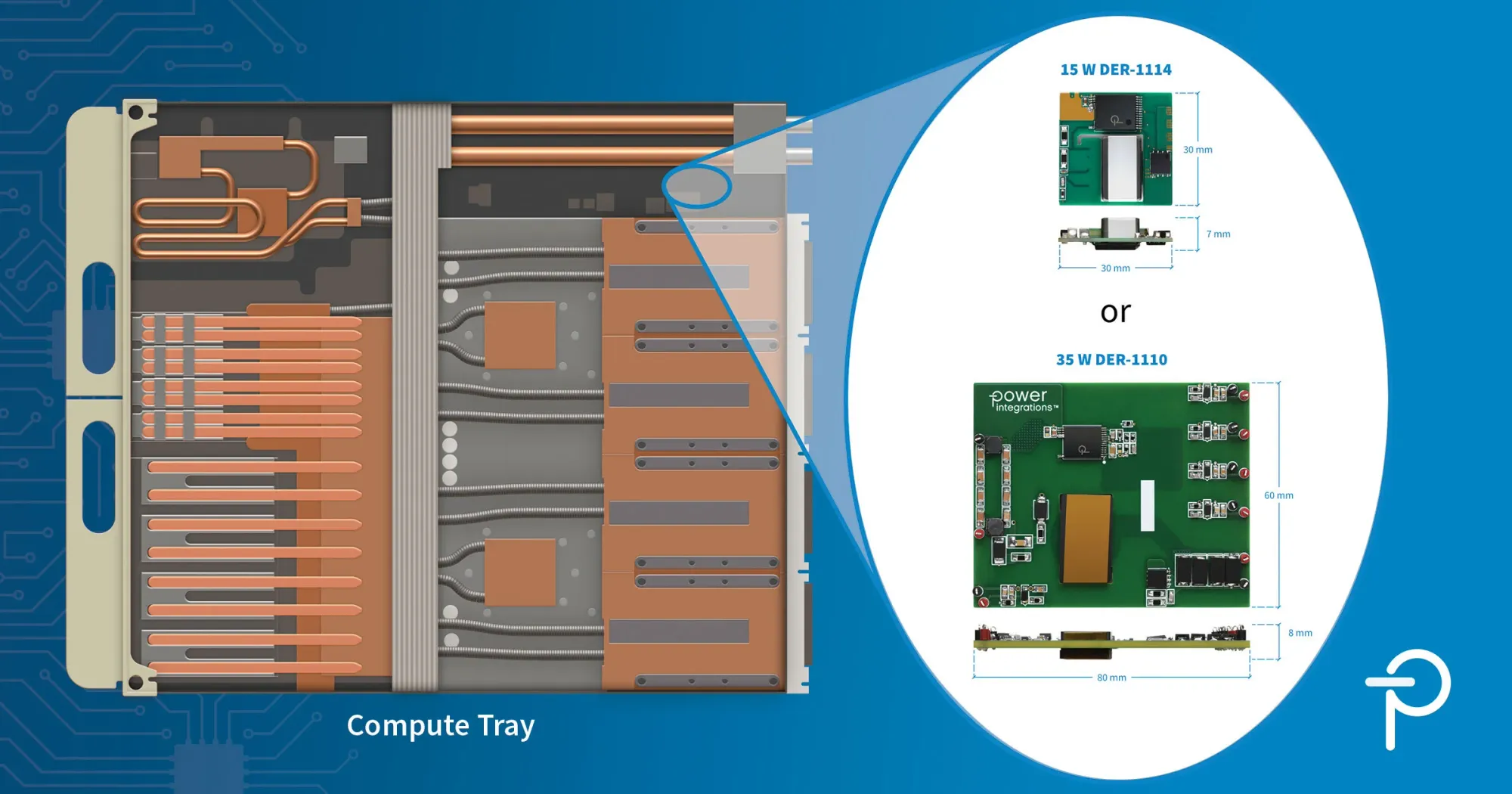
Power Integrations introduced a single‑output 15 W design measuring 30 mm × 30 mm × 7 mm and an isolated six‑rail 35 W design sized 80 mm × 60 mm × 8 mm. Both are built around the company’s InnoMux‑2 ICs that incorporate 1700 V‑rated PowiGaN™ gallium‑nitride (GaN) technology. The reference designs are optimized for the Kyber blade‑rack architecture and claim to free roughly 30 % of space on densely populated main power distribution boards (PDBs) and cut BOM components by about 30 %. Efficiency is reported at a minimum of 88 % across line and load conditions, with the InnoMux‑2 IC capable of flat 90 % efficiency in discontinuous conduction mode.
Design Architecture and Component Choices
The 15 W and 35 W units use single‑HEMT 1700 V GaN devices, which Power Integrations states are the only such offerings in the market. According to senior training manager Jason Yan, “The only alternative solutions are discrete, costly silicon carbide (SiC) devices which require 30 percent more components and space to operate.” Both reference designs employ flyback converter topologies to deliver auxiliary power for internal components such as micro‑controllers, gate drivers, and operational amplifiers—functions essential for control, housekeeping, and system safety in high‑voltage AI data centers.
Availability and Supporting Resources
The design examples, designated DER‑1110 (35 W multi‑output) and DER‑1114 (15 W single‑output), are available for free download from Power Integrations’ website. Interested parties can obtain further technical details through the company’s sales representatives or authorized distributors, including DigiKey, Newark, Mouser, and RS Components.
Key Takeaways
- Power Integrations released 15 W (30 mm × 30 mm × 7 mm) and 35 W (80 mm × 60 mm × 8 mm) ultra‑slim auxiliary PSU reference designs for NVIDIA Kyber 800 VDC AI data centers.
- The designs claim roughly 30 % reduction in board space and BOM count, with at least 88 % efficiency across operating conditions.
- Both reference designs rely on InnoMux‑2 ICs featuring 1700 V‑rated PowiGaN™ single‑HEMT technology, positioned as a lower‑component alternative to discrete SiC solutions.
EnergyInsyte's Take
The ultra‑compact aux PSUs could help data‑center operators increase rack density while simplifying power‑distribution layouts, a practical benefit in space‑constrained facilities. However, performance and cost comparisons with existing SiC‑based solutions remain to be validated in real deployments. Executives should monitor early field data and pricing to assess whether the claimed BOM and space savings translate into measurable ROI.
Source: Businesswire