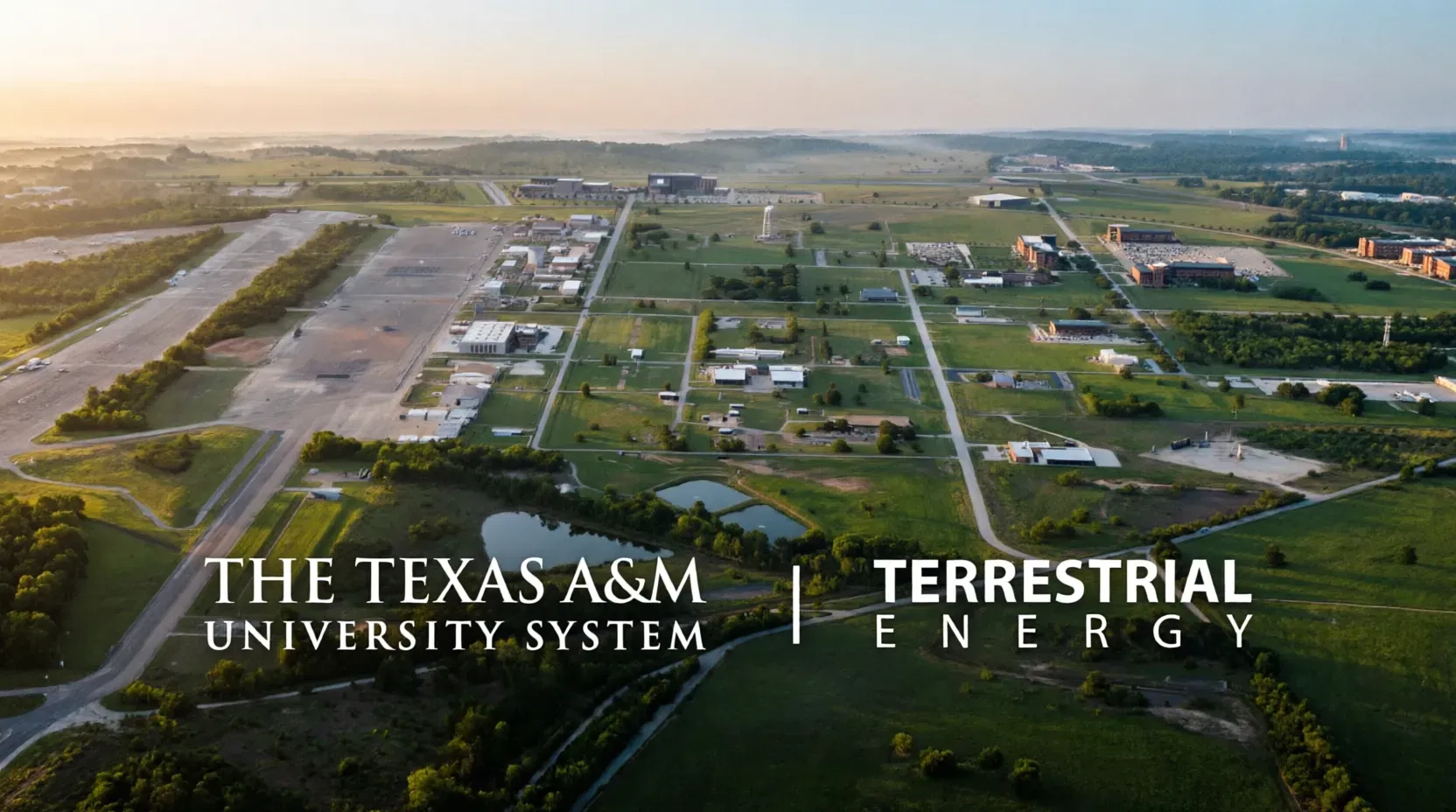
Terrestrial Energy and The Texas A&M University System have signed a ground‑lease and research‑and‑development agreement that gives Terrestrial exclusive access to roughly 77 acres at the RELLIS campus in Bryan, Texas. The deal enables site‑characterization work needed for a Nuclear Regulatory Commission (NRC) construction permit and supports Department of Energy (DOE)‑authorized pilot projects, marking a concrete step toward a commercial Integral Molten Salt Reactor (IMSR) plant in Texas. The agreement builds on a 2025 Memorandum of Understanding (MOU) that first identified the RELLIS Energy Proving Ground as a strategic location for advanced nuclear testing, and it formalizes a partnership that combines Terrestrial’s Generation IV reactor technology with the university system’s extensive engineering, research, and workforce‑development capabilities. By securing a dedicated 77‑acre parcel, Terrestrial gains a stable, controllable environment for engineering validation, supply‑chain integration, and regulatory data collection—activities that are essential for moving from conceptual design to a licensable, build‑ready plant.
Terrestrial Energy and Texas A&M System Sign Lease and R&D Agreements
The agreements, signed in early 2026, grant Terrestrial Energy exclusive rights to the 77‑acre parcel within the RELLIS Energy Proving Ground. The land will host facilities for IMSR testing, engineering, and supply‑chain activities, as well as DOE partnership projects named TETRA and TEFLA. Under a Master Research Agreement executed in the first quarter of 2026, Terrestrial opened an engineering and project‑management office on site to coordinate these efforts.
The lease also obligates the Texas A&M System’s Board of Regents to approve any nuclear activities before they commence. Site‑characterization and environmental evaluations, which began in 2025, will generate the detailed data required for an NRC construction‑permit application for the planned commercial IMSR plant and associated infrastructure. These evaluations include geotechnical surveys, seismic assessments, and radiological baseline studies, all of which are prerequisites for the NRC’s safety review process.
“This agreement captures the vision announced with the 2025 MOU and allows our Company to move forward with a powerful partnership across multiple projects,” said Simon Irish, CEO of Terrestrial Energy. “It deepens our relationship with one of the nation’s leading nuclear engineering institutions and accelerates project activities.”
In addition to the lease, the Master Research Agreement outlines collaborative research milestones, such as joint testing of IMSR fuel‑salt chemistry, validation of high‑temperature heat‑exchange modules, and integration of supply‑chain logistics for low‑enriched uranium fuel. Terrestrial’s on‑site engineering team will work closely with A&M faculty and graduate students, leveraging the university’s extensive nuclear engineering curriculum and its access to national laboratory resources.
Project Context: Advancing IMSR Commercial Deployment at RELLIS
The lease follows a 2025 Memorandum of Understanding (MOU) that selected Terrestrial Energy for the Texas A&M Energy Proving Ground initiative, a state‑backed effort to bring advanced nuclear capacity to the campus. The initiative aligns with Texas policy goals set by Governor Abbott and the state legislature to fast‑track advanced nuclear technologies for the ERCOT grid, which is experiencing rapid load growth from data centers, advanced manufacturing, and other energy‑intensive sectors.
Terrestrial’s plan includes completing the site‑characterization work, securing an NRC construction permit, and constructing a commercial IMSR plant on the RELLIS site in the early 2030s. The company also participates in the Greater Brazos Partnership and local workforce‑development programs to build a skilled labor pool for advanced nuclear projects. These programs provide apprenticeships, certification courses, and hands‑on training that align with the specific needs of small modular reactor (SMR) construction and operation.
In parallel, Terrestrial announced an MOU with Riot Platforms (May 2026) to explore IMSR‑powered large‑scale data‑center projects targeting up to 4 GW of generating capacity. The partnership envisions using the IMSR’s high‑temperature heat for both electricity generation and direct process heat, offering data‑center operators a low‑carbon, resilient power source that can also operate on natural gas as a bridge fuel during early commercial deployment.
Regulatory progress has been steady. In April 2026, the NRC issued a safety evaluation on Terrestrial’s Topical Report covering IMSR postulated initiating events, confirming that the company’s risk‑assessment methodology meets agency expectations. This follows a late‑2025 NRC safety evaluation of the Topical Report on IMSR Principal Design Criteria, which validated the core safety concepts of the reactor’s passive cooling and low‑pressure containment design. Both evaluations are foundational steps toward an operating license and demonstrate that the NRC is actively engaging with Terrestrial’s design package.
The RELLIS site also serves as a hub for DOE‑authorized pilot projects. Project TETRA focuses on testing advanced reactor control algorithms and digital twins, while TEFLA concentrates on fuel‑line fabrication and qualification. By co‑locating these pilots with the commercial‑plant development effort, Terrestrial can iterate design improvements rapidly and feed real‑world data back into the licensing dossier.
Market Relevance: Advanced Nuclear’s Role in Texas’ Growing Grid
Texas’ electricity market, managed by ERCOT, is expanding quickly, driven by high‑growth, carbon‑free demand from data centers and industrial users. State policy encourages advanced nuclear as a firm, dispatchable source that can complement intermittent renewables and support grid reliability. The RELLIS agreement positions Texas A&M‑RELLIS as a hub for advanced‑energy testing, offering companies a pathway from laboratory concepts to commercial deployment. By providing a dedicated site, engineering expertise, and a pipeline of skilled graduates, the partnership could reduce the time and cost associated with site licensing and construction for small modular reactors (SMRs).
Local officials highlighted the broader economic impact. Bryan Mayor Bobby Gutierrez noted that the partnership helps the city become “a vital hub for progress and innovation.” The Texas A&M System’s Board of Regents chairman, Robert L. Albritton, emphasized that advanced nuclear “will be essential to America’s security, economic growth and energy independence.” Chancellor Glenn Hegar added that the university system’s mission is to apply research to solve real problems, underscoring the strategic fit of the RELLIS project within Texas’ energy‑security agenda.
While the agreements do not guarantee financing or regulatory approval, they create a tangible framework for Terrestrial to advance its IMSR commercial pipeline in a market that values reliable, low‑carbon baseload capacity. The combination of state‑level incentives, a clear path to NRC licensing, and a collaborative university environment makes the RELLIS site one of the most promising locations for early SMR commercialization in the United States.
Key Takeaways
- Terrestrial Energy and the Texas A&M University System signed lease and R&D agreements granting exclusive access to 77 acres at the RELLIS campus for IMSR testing and site‑characterization work.
- The agreements enable Terrestrial to gather data needed for an NRC construction‑permit application and support DOE‑authorized pilot projects (TETRA and TEFLA).
- The partnership aligns with Texas policy to accelerate advanced nuclear deployment on the ERCOT grid, addressing growing demand from data centers and industrial users.
EnergyInsyte's Take
The RELLIS site gives Terrestrial a concrete foothold for its first commercial IMSR plant, but the path to an NRC permit and financing remains uncertain. Executives should monitor the NRC’s next licensing milestones, the outcome of the Riot Platforms data‑center partnership, and any state policy adjustments that could affect advanced nuclear incentives in Texas.
Source: Businesswire