
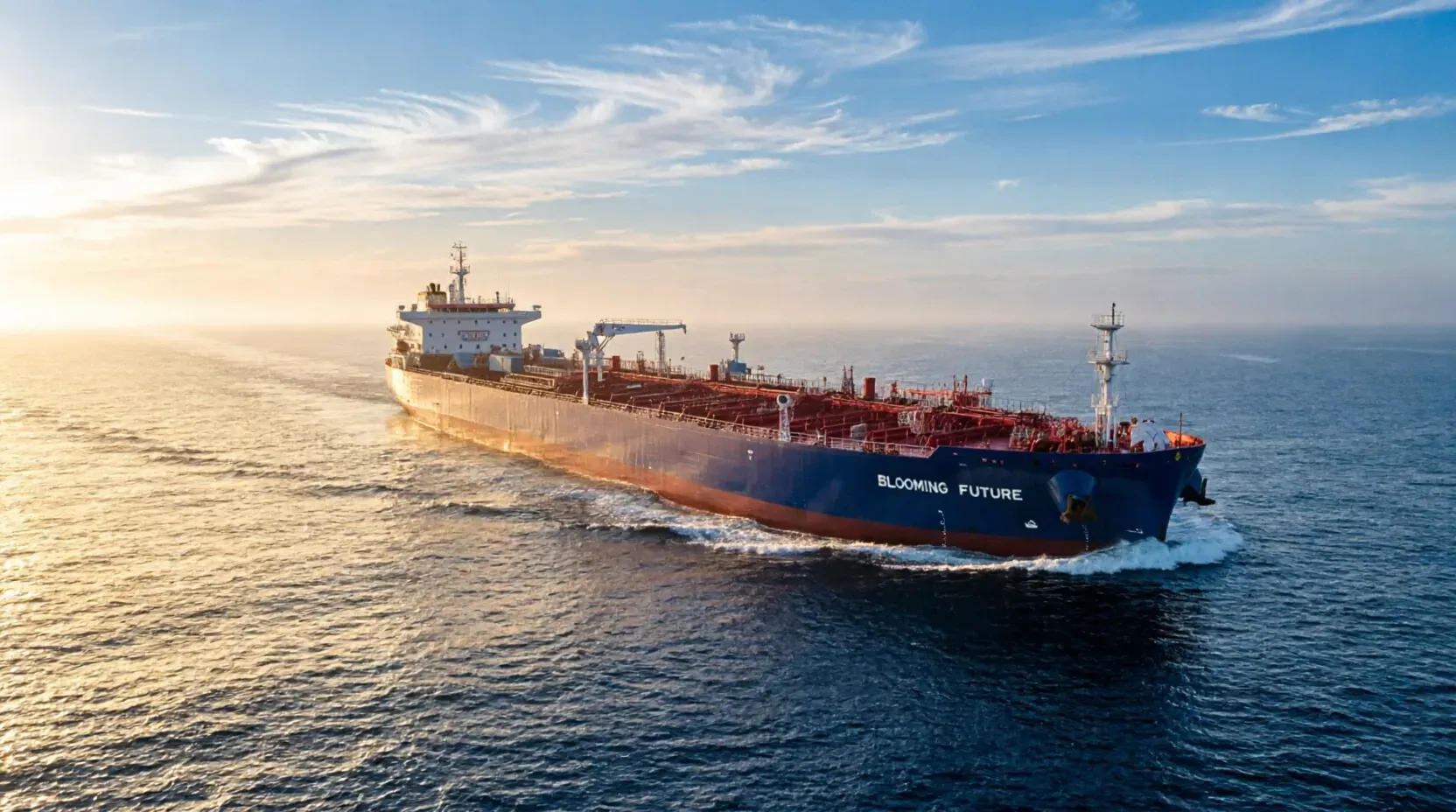
Braskem Trading & Shipping (BT&S) has begun operations of Bloom Future, the company’s first next‑generation LR1 chemical and product oil tanker. The vessel was formally named during a ceremony in China on May 8, underscoring Braskem’s push to modernize its maritime fleet. Designed for long‑range transport of essential raw materials such as naphtha, Bloom Future combines a massive cargo capacity with advanced, lower‑carbon technologies. By operating at an optimized speed and featuring biofuel‑ready engines, the tanker is expected to deliver a significant reduction in fuel consumption and CO₂ output, aligning the company’s shipping footprint with its broader sustainability agenda across its global supply chain.
Bloom Future Begins Maiden Voyage
Bloom Future is built as an IMO Type 3 chemical and product oil tanker, a classification that emphasizes safety, reliability, and environmental performance. Its cargo holds can accommodate volumes equivalent to roughly 35 Olympic‑size swimming pools, and its beam is as wide as a six‑lane highway, illustrating the sheer scale of the vessel. Hardi Schuck, Director of Braskem Trading & Shipping, highlighted that the ship’s design meets the highest standards of safety while integrating biofuel‑ready engines and other energy‑efficient systems. These technologies enable the tanker to run at an optimized speed that trims fuel use and cuts emissions. Braskem projects that Bloom Future will emit about 30 % less CO₂ than the average vessels currently in its fleet, which translates to an estimated 6,500 tonnes of CO₂ avoided each year. The maiden voyage therefore serves as a practical test of how lower‑emission maritime transport can be scaled without compromising the reliable delivery of feedstocks to the company’s polyolefin and biopolymer plants in Brazil, the United States, Mexico, and Germany.
Fleet Expansion Targets Early 2027
Bloom Future is the inaugural unit of a planned quartet of LR1 tankers that Braskem aims to have in service by early 2027. This expansion is a core component of BT&S’s broader “Seas of the Future” program, which seeks to improve logistics efficiency, lower freight costs, and further reduce CO₂ emissions across the company’s global shipping activities. By adding three more vessels of similar capability, Braskem intends to reinforce the reliability and safety of its maritime operations while steadily decreasing the carbon intensity of its supply chain. The program reflects Braskem’s commitment to sustainable maritime transport, positioning the company to meet growing demand for its plastics and chemicals while adhering to its environmental targets.
Implications for Energy and Chemical Supply Chains
The launch signals Braskem’s commitment to integrating lower‑emission transport into its feedstock and product logistics. By using a vessel designed for optimized speed and biofuel compatibility, the company seeks to align its shipping footprint with broader sustainability goals while maintaining the reliability needed for continuous raw‑material supply to its production sites in Brazil, the United States, Mexico, and Germany.
Key Takeaways
- Bloom Future was formally named on May 8 in China and will transport naphtha with an estimated 30 % lower CO₂ emissions than Braskem’s average vessels.
- The tanker’s advanced technologies are projected to cut about 6,500 tonnes of CO₂ annually.
- Braskem plans to operate a total of four LR1 tankers by early 2027 as part of its “Seas of the Future” sustainability program.
EnergyInsyte's Take
Bloom Future’s entry into service demonstrates how a major petrochemical producer can embed emissions‑reduction measures directly into its logistics chain. Executives should monitor the performance data from this vessel and the subsequent three tankers to assess whether the projected fuel‑efficiency gains materialize at scale. The rollout also raises questions about biofuel availability and the cost balance of lower‑emission operations versus traditional shipping options.
Source: Businesswire