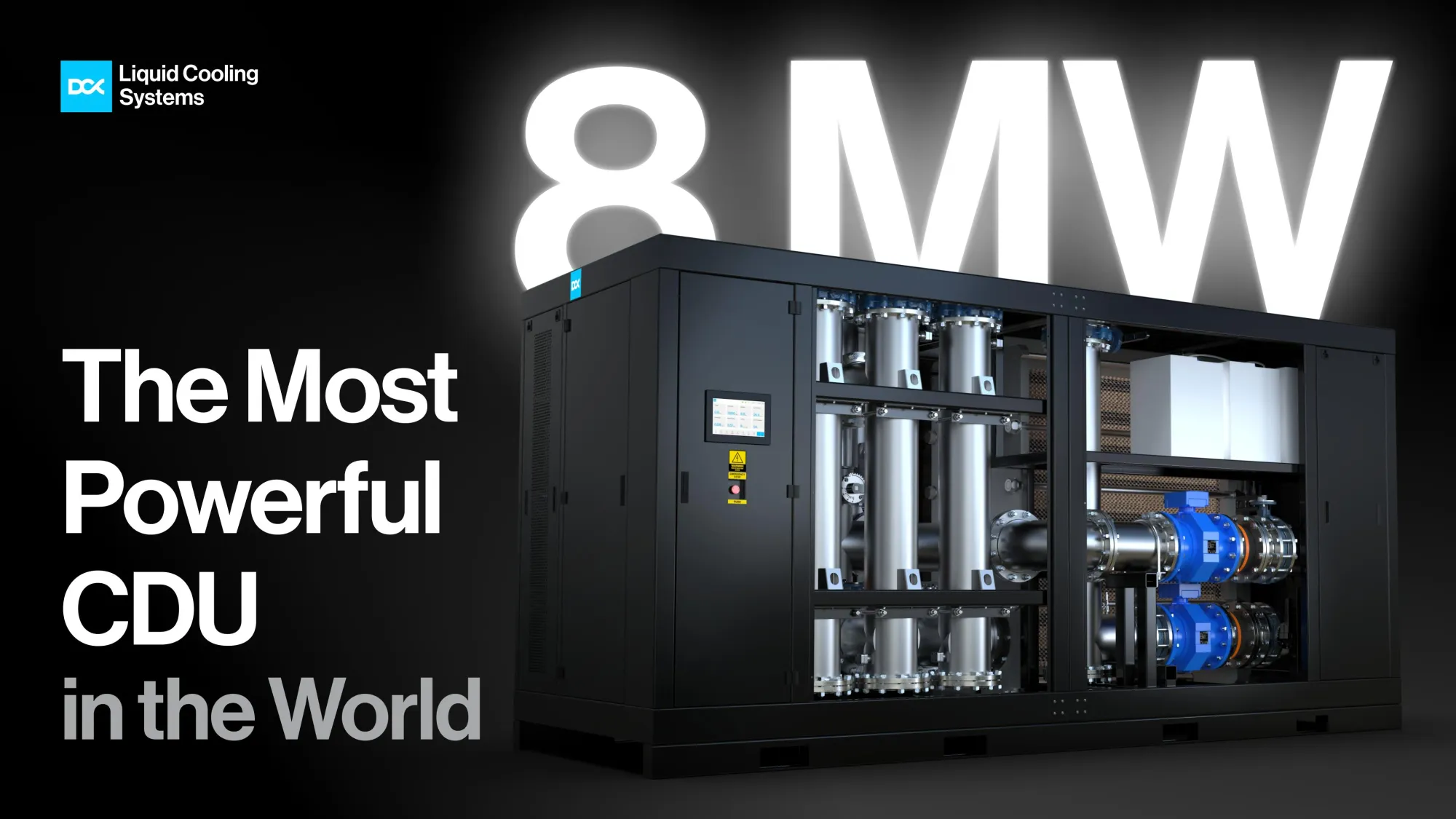
The rapid scaling of AI-driven data centers is shifting the primary risk profile of liquid cooling from simple heat rejection to complex chemical management. DCX Liquid Cooling Systems has announced the launch of its Facility Distribution Unit (FDU) family, which integrates continuous coolant monitoring and automated chemical dosing directly into the hardware. These hyperscale-class units, capable of managing up to 8 MW of heat transfer, aim to replace traditional, manual sampling methods with real-time, inline sensor technology. By embedding these controls within the distribution unit, the company is positioning its hardware as a critical security layer for the fluid loops that serve high-density AI infrastructure, addressing the potential for "chemistry drift" to degrade cooling performance in mission-critical environments.
Automated Chemical Management in the DCX FDU
DCX is attempting to close a technical gap in hyperscale deployments by moving coolant quality assurance from a scheduled, reactive process to a continuous, proactive one. The new FDU family features built-in inline sensors designed to monitor eight coolant parameters, including turbidity, conductivity, pH, glycol concentration, and corrosion rates. Rather than relying on periodic laboratory results, the system utilizes integrated electronic dosing pumps to provide automatic treatment.
The hardware includes three automatic dosing channels capable of delivering inhibitors, biocides, and pH control additives. According to the company, the controller is designed to hold pH at a specific set point and treat fresh make-up fluid in proportion to its volume. This automation is intended to keep the entire coolant loop within specification between scheduled service visits. The FDU is engineered to serve entire AI data halls from outside the white space, supporting both PG25 and deionized-water loops. With a capacity of up to 8 MW of heat transfer at a 2 °C approach temperature and a flow rate of 3000 GPM (11,000 LPM), the unit utilizes four pumps in either N+N or N+1 configurations to maintain operational redundancy.
Mitigating Operational Risks in AI-Scale Cooling
As data centers transition to liquid cooling to support high-density AI workloads, the stability of the cooling medium becomes a central component of infrastructure reliability. DCX is framing the management of coolant chemistry as a matter of critical-infrastructure security rather than mere maintenance. In traditional models, operators sample fluid and wait for lab results, a delay that the company suggests can lead to unmanaged chemistry drift and compromised cooling performance.
By integrating the dosing controller and sensors into the same frame that moves the coolant, DCX is targeting the specific vulnerabilities of hyperscale-class deployments. The company's CTO, Maciek Szadkowski, stated that at this scale, the coolant is as critical as the pumps themselves. This approach suggests that as heat loads increase toward the 8 MW threshold per unit, the margin for error in fluid chemistry narrows significantly. The FDU provides operators with a live diagram of both cooling loops, including pumps, valves, and dosing lines, via a touchscreen interface. This level of visibility is intended to provide a new layer of safety for the most critical cooling infrastructure within the "AI factory" model.
Key Takeaways
- DCX's FDU family provides up to 8 MW of heat transfer capacity with a 2 °C approach temperature and 3000 GPM flow rate.
- The system features continuous inline monitoring of eight parameters and three automatic dosing channels for inhibitors, biocides, and pH additives.
- The technology is supported by a significant capital position, following a USD 176.08 million investment from LITEON Technology Corporation at a USD 704 million valuation.
EnergyInsyte's Take
In our view, DCX is correctly identifying a looming bottleneck in the deployment of high-density AI clusters: the transition from mechanical reliability to chemical stability. While the industry has focused heavily on pump redundancy and heat exchanger efficiency, the "chemistry drift" mentioned by DCX represents a silent threat to long-term asset integrity. By embedding dosing pumps and sensors directly into the 8 MW FDU, DCX is moving toward a "set-and-forget" model for fluid chemistry that is essential for hyperscale operators who cannot afford the downtime associated with manual sampling. This shift signals that as cooling loops grow in scale and complexity, the distribution unit must evolve from a simple hydraulic component into an intelligent, self-regulating chemical management system. This integration could become a standard requirement for any facility managing the extreme thermal densities required by next-generation AI hardware.
Questions & Answers
How does the DCX FDU manage chemical dosing automatically?
The FDU utilizes three automatic dosing channels equipped with electronic dosing pumps. These pumps deliver inhibitors, biocides, and pH control additives based on continuous data from inline sensors. The integrated controller is designed to maintain pH at a set point and treat make-up fluid in proportion to its volume, with all doses being counted and logged.
What are the primary technical specifications for the FDU's heat transfer capabilities?
The FDU family is capable of up to 8 MW of heat transfer capacity. It operates with a 2 °C approach temperature and a 45 °C supply temperature (ASHRAE W45/W+). The system supports flow rates up to 3000 GPM (11,000 LPM) and utilizes four pumps configured in either N+N or N+1 redundancy.
Which coolant types are supported by this new distribution unit?
The DCX FDU is designed to support both PG25 and deionized-water loops, providing flexibility for different data center cooling architectures.
What is the strategic significance of the LITEON Technology Corporation investment in DCX?
LITEON Technology Corporation has invested USD 176.08 million in DCX, acquiring a minority stake at a company valuation of USD 704 million. This capital injection provides the financial backing necessary for DCX to scale its manufacturing and R&D operations, which remain based in Poland, to meet hyperscale demand.
Source: DCX