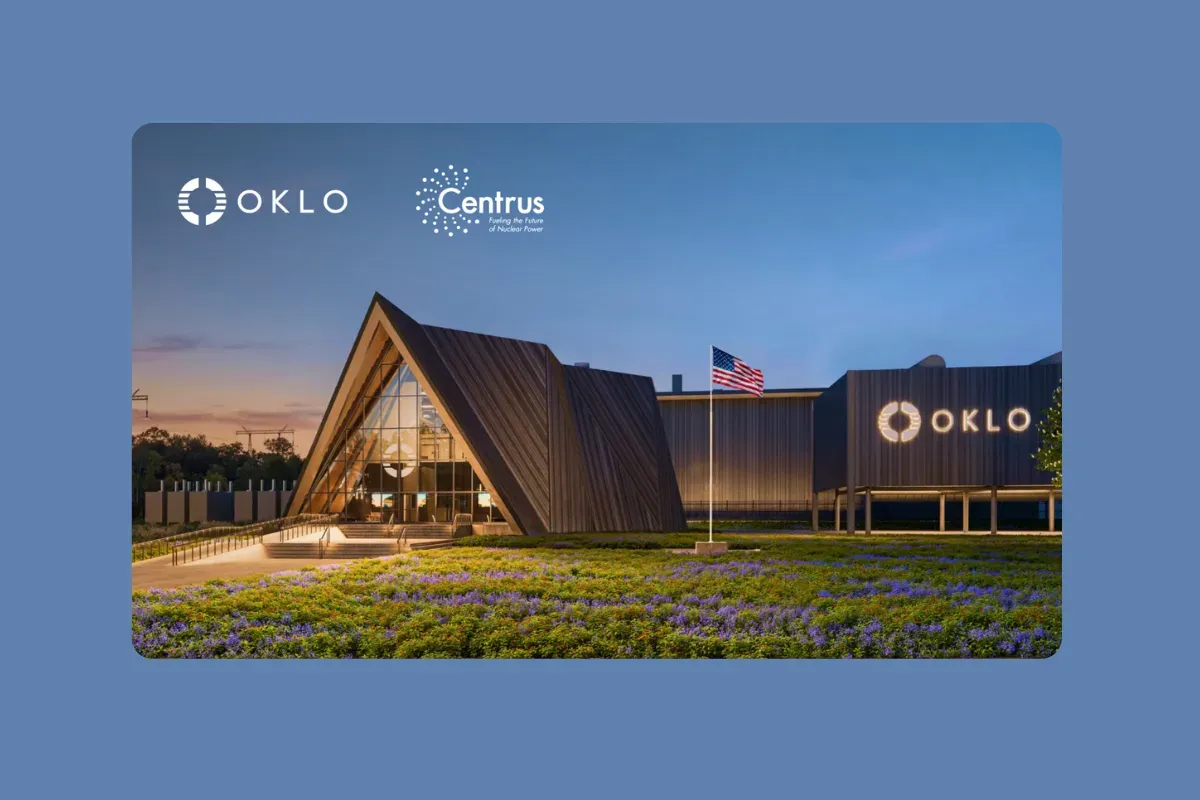
Oklo Inc. and Centrus Energy Corp. have signed a Letter of Intent (LOI) that marks one of the first large‑scale commercial agreements for high‑assay low‑enriched uranium (HALEU) in the United States. Under the LOI, Centrus will supply enough domestic HALEU to fuel up to five of Oklo’s Aurora powerhouses, which are slated to be built at the company’s 1.2 GW Clean Energy Campus in southern Ohio. Deliveries are scheduled to begin in 2029, and the agreement may incorporate pre‑payments from Oklo—an approach that mirrors the company’s January 2026 arrangement with Meta to secure fuel certainty early in the project lifecycle. By linking Centrus’s enrichment capacity at its American Centrifuge Plant in Piketon, Ohio, with Oklo’s advanced reactor deployment plan and Kiewit Nuclear Solutions’ engineering, procurement, and construction (EPC) expertise, the LOI creates a concrete supply‑chain pathway that could alleviate the HALEU bottleneck that has long constrained the advanced nuclear sector. The partnership also signals a broader shift toward domestically sourced nuclear fuel, leveraging billions of dollars in private capital and a $900 million Department of Energy (DOE) HALEU task order to underpin the commercial rollout.
Oklo‑Centrus Letter of Intent Details
The LOI commits Centrus to provide HALEU from its American Centrifuge Plant in Pike County, Ohio, sufficient to support multiple years of operation for up to five Aurora powerhouses. While the LOI is not a binding purchase contract, it sets the stage for a definitive agreement that will formalize quantities, pricing, and delivery schedules. The document explicitly mentions the possibility of pre‑payment mechanisms—similar to the pre‑payment Oklo made to Centrus in early 2026 for its Meta partnership—to help fund the fuel‑supply chain ahead of the first reactor start‑up.
Centrus plans to leverage “billions in private capital” together with the previously announced $900 million DOE HALEU task order to meet the supply commitment. The company’s expansion, which began late last year, is projected to create roughly 1,000 construction jobs and 300 new operating positions in Ohio, while retaining the 150 jobs already present at the Piketon facility. This expansion is essential for scaling enrichment capacity to the levels required for advanced reactors, a goal that Centrus describes as a “crucial milestone” in restoring America’s ability to enrich uranium at scale.
Oklo’s Aurora reactors are fast‑fission, liquid‑metal‑cooled units designed for a build‑own‑operate model. They feature low water usage, inherent safety characteristics, and a small physical footprint, making them well‑suited for industrial sites in southern Ohio. Each powerhouse is expected to generate between 40 MW and 50 MW of clean electricity, and Oklo projects that each unit will support 40‑50 permanent, well‑paying jobs covering technical support, engineering, administration, logistics, routine maintenance, and periodic refueling. When a cluster of eight units is operational, an additional 80‑120 permanent roles will be created to manage site‑wide functions.
Infrastructure and Workforce Implications for Southern Ohio
The LOI aligns three critical infrastructure components: Centrus’s enrichment capacity, Oklo’s Aurora campus, and Kiewit’s EPC expertise. Kiewit Nuclear Solutions has already signed a memorandum of understanding (MOU) with Oklo to support engineering, procurement, and construction planning for the initial Aurora deployments. This collaboration reinforces southern Ohio’s existing nuclear expertise, which includes decades of experience from the region’s historic fuel‑fabrication and reactor‑operation activities.
Oklo estimates that the Aurora campus will attract “multi‑billion‑dollar private clean energy investment” and generate hundreds of jobs across construction and operations. Construction of the first wave of powerhouses will require more than 700 full‑time workers over several years, reflecting the labor‑intensive nature of building advanced nuclear facilities. For every eight powerhouses, the company expects an extra 80‑120 permanent positions to support site‑wide operations, encompassing everything from technical engineering to warehouse logistics and routine refueling. The combined effort could transform southern Ohio into a hub for advanced nuclear manufacturing and operation, complementing existing industrial activity and providing a domestic source of HALEU that has been a persistent bottleneck for the sector.
Centrus’s expansion in Piketon is projected to generate 1,000 construction jobs and 300 operating jobs, adding to the 150 jobs retained from the plant’s prior operations. This workforce boost not only supports the immediate fuel‑supply needs of the Aurora project but also builds a broader skilled labor pool that can serve future advanced‑reactor deployments across the United States.
Market Signal: Domestic HALEU Supply Gaining Traction
Access to domestically produced HALEU has been widely identified as a central constraint for the deployment of next‑generation reactors. By tying a commercial fuel supply to a specific project pipeline, the Oklo‑Centrus LOI offers a tangible example of how private capital, federal funding, and regional supply chains can converge to de‑risk advanced nuclear projects. Centrus’s President and CEO Amir Vexler described the LOI as “an important step toward ensuring reliable HALEU supply for next‑generation reactors” and emphasized its role in establishing a foundation for a new U.S. advanced nuclear energy hub.
Although the LOI does not yet lock in purchase volumes, its structure—potential pre‑payments, a clear timeline for deliveries beginning in 2029, and alignment with the DOE’s $900 million HALEU task order—signals a level of commercial confidence that could encourage other developers to pursue similar arrangements. The partnership demonstrates that a domestic HALEU market can be built through coordinated effort among enrichment providers, reactor developers, and construction firms, thereby reducing reliance on foreign sources and mitigating supply‑chain uncertainties.
Key Takeaways
- Centrus will supply enough HALEU from its Piketon, Ohio plant to fuel up to five Aurora powerhouses, with deliveries scheduled to start in 2029.
- The LOI may include pre‑payments from Oklo, mirroring a similar arrangement made with Meta in January 2026.
- Construction and operation of the Aurora campus are projected to create over 700 construction jobs and 40‑50 permanent jobs per powerhouse, with additional site‑wide roles as the cluster expands.
EnergyInsyte's Take
The Oklo‑Centrus LOI provides a concrete pathway for domestic HALEU to reach advanced reactors, reducing a key supply‑chain risk for the sector. Executives should monitor the forthcoming definitive agreement and any financing milestones, as these will determine the pace at which the Aurora campus can move from planning to construction. The partnership’s reliance on pre‑payment mechanisms also highlights the growing role of private capital in de‑risking nuclear fuel supply.
The next steps will hinge on Oklo securing the necessary site‑specific permits and finalizing financing for the 1.2 GW campus. If the definitive fuel supply contract is signed by late 2026, Centrus will need to scale its enrichment lines at Piketon to meet the projected 2029 start‑up, a timeline that aligns with the DOE’s broader HALEU roadmap. Stakeholders should also watch for any updates to the DOE’s $900 million HALEU task order, as additional funding could accelerate Centrus’ capacity build‑out and further solidify the supply chain for other emerging reactor designs.
Overall, the Oklo‑Centrus LOI signals a maturing market for advanced nuclear fuel, moving the conversation from “if” to “when” domestic HALEU will be reliably available for commercial reactors.
Source: Businesswire