
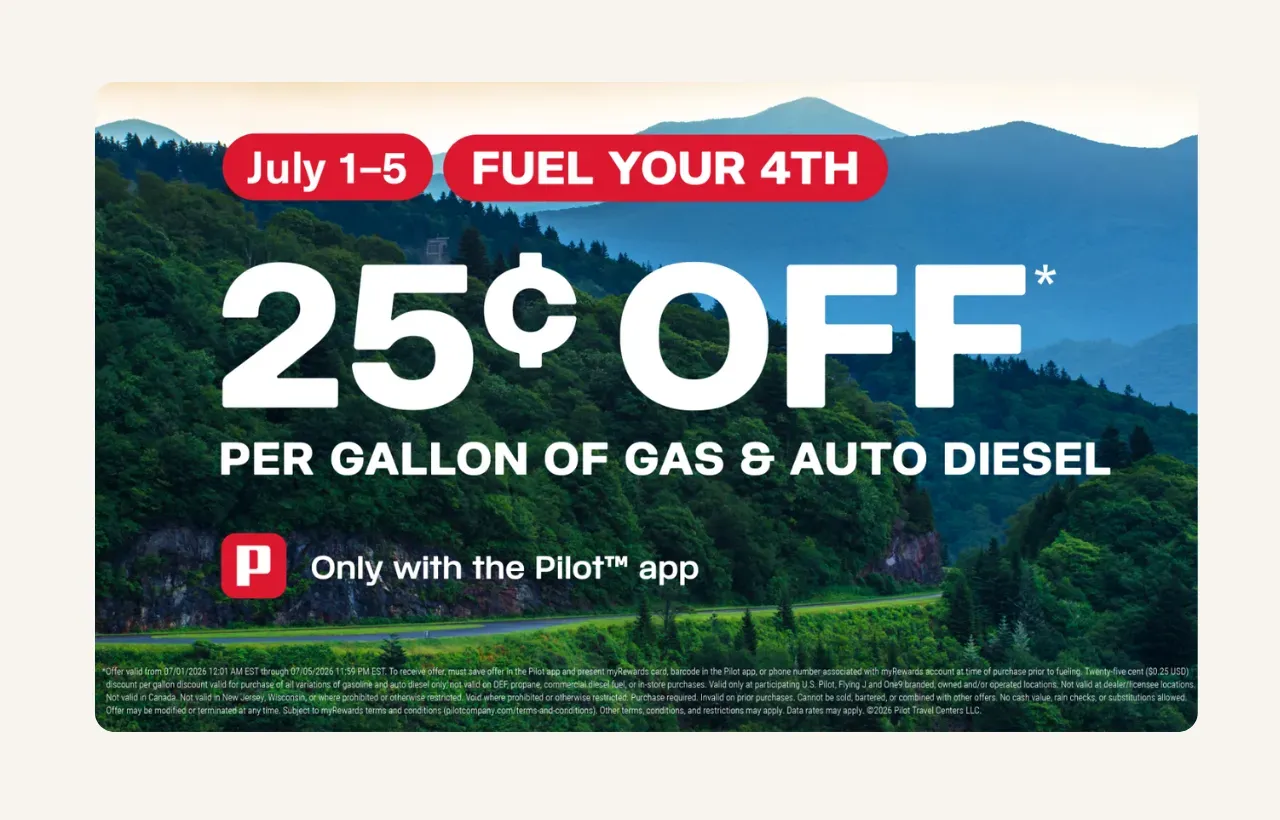
Pilot Travel Centers is offering a limited‑time discount of $0.25 per gallon of gasoline or auto‑diesel at participating Pilot, Flying J and One9 locations nationwide from July 1‑5 2026. The promotion, delivered through the Pilot mobile app, is aimed at the more than 61 million Americans projected by AAA to travel by car over the Fourth of July holiday. By positioning the discount within the Pilot app’s rewards screen and coupling it with a suite of in‑store food deals—hand‑roped pizza, new chicken tenders, and a range of drinks—Pilot seeks to capture a larger share of the holiday road‑trip spend while reinforcing its brand as the “go‑to” stop for long‑distance drivers. The offer runs from 12:01 a.m. EST on July 1 through 11:59 p.m. EST on July 5, and requires guests to save the offer in the app before redeeming it at the pump or inside the store. After the holiday weekend, the app continues to provide a $0.10‑per‑gallon discount each month for users who claim it, extending the incentive well beyond the peak travel days.
Pilot Launches $0.25‑Per‑Gallon Holiday Offer
The discount is available to guests who save the offer in the Pilot app, then present a myRewards barcode, card or phone number at the pump or inside the store before fueling. The offer applies to all variations of gasoline and auto‑diesel and is limited to U.S. Pilot, Flying J and One9 branded, owned or operated locations; it is excluded in Canada, New Jersey, Wisconsin and other jurisdictions where prohibited. The redemption process is straightforward: users tap the limited‑time offer on the rewards screen, claim it, and then scan the barcode or enter their myRewards number at the point of sale. This digital workflow not only speeds up the checkout experience but also feeds real‑time redemption data back to Pilot’s demand‑forecasting systems.
Kari Irons, Pilot’s chief experience officer, said, “As we celebrate our country’s 250th anniversary this Fourth of July, we’re proud to keep fueling iconic road trips across the nation.” The company also highlights ancillary savings on food and beverage items such as hand‑roped pizza and new chicken tenders, encouraging travelers to maximize the value of each stop. By bundling fuel savings with popular “Pilot eats” items, the promotion leverages cross‑selling opportunities that can lift average transaction size, a tactic that aligns with Pilot’s broader strategy of enhancing the overall travel‑center experience.
Relevance to Energy Executives and Grid Operators
The promotion coincides with a peak travel period that strains regional fuel distribution and retail infrastructure. Pilot operates the third‑largest fuel tanker fleet in North America and supplies roughly 12 billion gallons of fuel annually across more than 900 locations in 43 U.S. states and five Canadian provinces. By incentivizing purchases through its digital platform, Pilot can better forecast demand spikes, smooth pump‑level inventory turnover, and reduce the likelihood of localized shortages during the holiday surge. The app‑based redemption also generates granular, time‑stamped data on fuel volumes, which can be shared with wholesale suppliers to fine‑tune delivery schedules.
For utilities and grid operators, the increased traffic at travel centers translates to higher electricity consumption for lighting, refrigeration, and emerging EV‑charging services. Pilot’s stated commitment to expanding its EV‑charging network and low‑carbon fueling alternatives suggests that the holiday traffic could also generate incremental load on local distribution circuits, a factor worth monitoring in capacity planning. The concentration of 1.2 million daily guests at Pilot sites means that even modest increases in EV‑charging sessions during the holiday weekend could create noticeable short‑term peaks, prompting utilities to consider demand‑response or load‑shaping measures in affected service areas.
Supply‑Chain and Investment Context
Pilot’s parent, Berkshire Hathaway Inc., backs the company’s extensive retail footprint and its fuel‑logistics capabilities. The firm’s annual fuel supply of 12 billion gallons underscores its role as a major downstream player in the North American energy market. While the discount does not alter wholesale fuel pricing, it may influence short‑term retail margins and drive higher volume throughput at participating sites.
The promotion’s exclusion of diesel fuel for commercial trucks and of DEF, propane, and other specialty fuels reflects Pilot’s segmentation strategy between consumer motorists and its trucking‑fleet services. Executives evaluating fuel‑supply contracts or retail partnership opportunities should note that the discount is limited to consumer‑grade gasoline and auto‑diesel, and that it is subject to myRewards terms, potential modification or termination at any time, and other standard restrictions.
Key Takeaways
- Pilot’s Fourth‑of‑July promotion offers $0.25 off each gallon of gasoline or auto‑diesel at participating U.S. Pilot, Flying J and One9 locations from July 1‑5 2026.
- The discount is delivered via the Pilot app and requires guests to present a myRewards barcode, card or phone number at the pump; a subsequent $0.10‑per‑gallon discount is available monthly after the holiday.
- Pilot operates over 900 travel‑center locations, supplies about 12 billion gallons of fuel per year, and serves an average of 1.2 million guests daily, positioning it as a significant downstream energy retailer during peak travel periods.
EnergyInsyte's Take
The holiday discount illustrates how a major fuel retailer can use digital incentives to manage demand spikes and gather real‑time consumption data. While the offer does not affect wholesale fuel economics, it may create short‑term retail volume gains and modest load increases at sites with EV‑charging capabilities. Executives should watch how Pilot’s app‑based redemption impacts pump‑level inventory and whether similar digital promotions become a broader tool for demand shaping across the fuel retail sector.
Source: Businesswire