RLCore announced RLTune, a real‑time continuous‑optimization platform for water and wastewater facilities, at the American Water Works Association’s ACE26 conference in Washington, D.C. The solution adds a learning intelligence layer to existing plant controls, aiming to cut chemical and energy use while improving operational resilience—outcomes that directly affect utility CIOs and plant managers. By embedding a constrained reinforcement‑learning engine directly into the control stack, RLTune seeks to replace static‑gain approaches with a system that continuously learns from live process data, adapts to fluctuating influent characteristics, and reacts to changing energy and chemical prices without requiring costly retrofits or extensive model development.
RLCore Introduces RLTune at ACE26
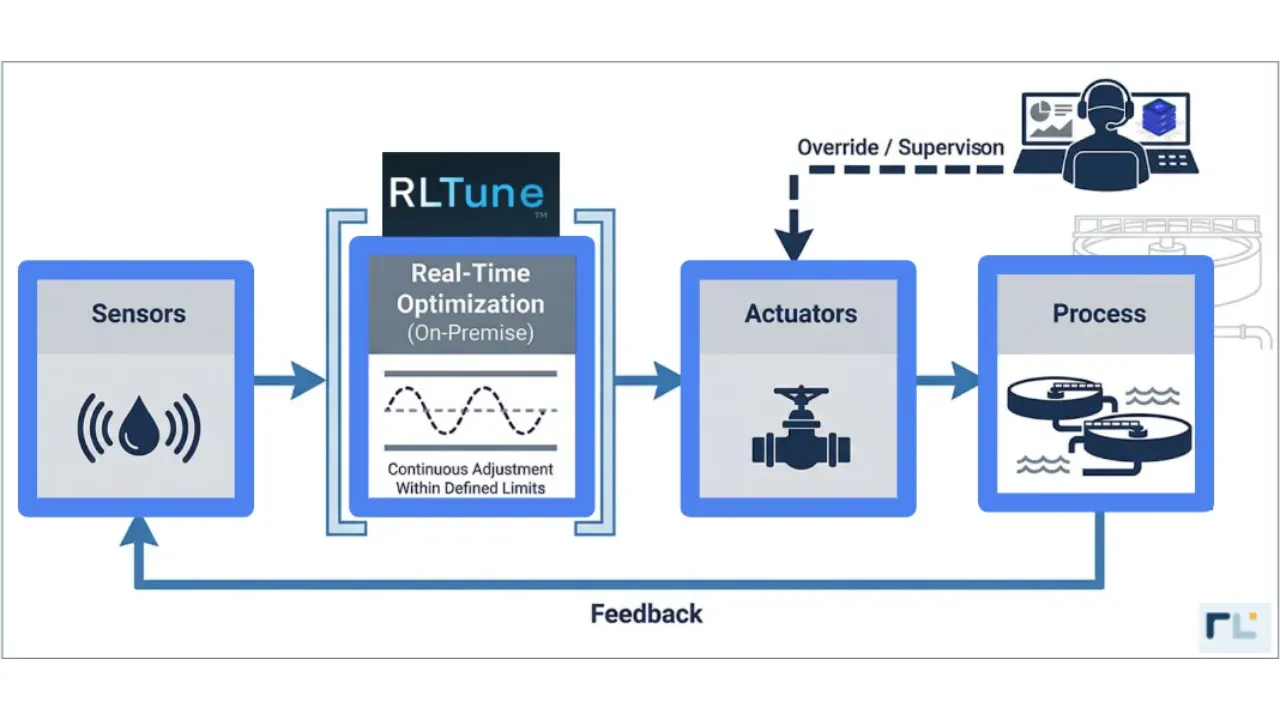
RLTune was unveiled during the ACE26 conference (June 21‑24, 2026). The platform sits on a plant’s existing control stack and applies constrained reinforcement learning to adjust control decisions in real time. According to RLCore, live deployments have produced 15‑25% reductions in chemical and energy consumption, a 95% increase in response time, and more than 90% process efficiency, along with notable gains in operational responsiveness and stability. The company cites analysts who estimate over $1 trillion is lost annually to controllable inefficiencies across industrial processes, underscoring the economic pressure on utilities to adopt smarter control strategies. RLCore’s messaging emphasized that most industrial control systems remain static despite operating in highly dynamic environments—daily shifts in energy pricing, influent variability, equipment wear, and staffing constraints. RLTune’s continuous‑learning engine is designed to fill that gap by learning directly from live plant data, eliminating the need for pre‑built digital twins or complex physics models and thereby shortening deployment timelines.
Platform Architecture and Core Capabilities
RLTune’s architecture relies on continuous learning rather than static models or digital twins. Key capabilities include:
- Continuous Learning and Adaptation – automatic adjustment to seasonal variability, influent changes, equipment wear, and process disturbances without manual retuning.
- No Digital Twins Required – the system learns directly from live plant data using a constrained, safe‑by‑design form of reinforcement learning, which RLCore says shortens deployment timelines.
- Guardrailed Optimization – operators define guardrails and retain explicit override authority, allowing incremental autonomy as trust grows.
- Data Logging – live operational data are logged for visibility without impacting plant performance.
- Vendor‑Agnostic Integration – OPC‑UA connectivity enables compatibility with SCADA, DCS, PLCs, historians, and IoT gateways.
- On‑Premise, Cyber‑Secure – data remain on site unless the plant authorizes external transfer.
CEO Ganesh Rao emphasized that “industrial control systems have remained largely static for decades… RLTune changes that paradigm.” CTO Martha White added that recent advances in reinforcement learning now make continuous, real‑world learning practical.
Relevance for Enterprise Utility Leaders
For utility CIOs and CTOs, RLTune offers a path to improve key performance indicators without extensive retrofits. Shelley Terry, GM of Infrastructure at Drayton Valley, reported lower chemical use, higher water conservation, and reduced operator workload after adopting RLCore’s solution. EPCOR Water Services’ Senior Vice President Frank Mannarino confirmed that the platform contributed to operational cost savings at a wastewater treatment plant. Because the system runs on‑premise and integrates with existing SCADA/DCS environments, it aligns with typical utility security policies and minimizes disruption to legacy workflows.
Key Takeaways
- RLTune applies constrained reinforcement learning to existing plant controls, delivering 15‑25% reductions in chemical and energy consumption in live deployments.
- The platform requires no digital twins, integrates via OPC‑UA, and keeps all data on‑premise, supporting vendor‑agnostic and cyber‑secure implementations.
- Utility leaders at Drayton Valley and EPCOR reported measurable performance improvements and operator time savings after adopting RLTune.
EnergyInsyte's Take
RLTune demonstrates that reinforcement‑learning techniques can be embedded in legacy utility control stacks without wholesale system replacement. While early results are promising, broader adoption will depend on demonstrable ROI at scale and the ability of plant operators to manage guardrails effectively. CIOs and CTOs should monitor pilot outcomes and assess integration effort against existing security and compliance frameworks.
Source: Businesswire