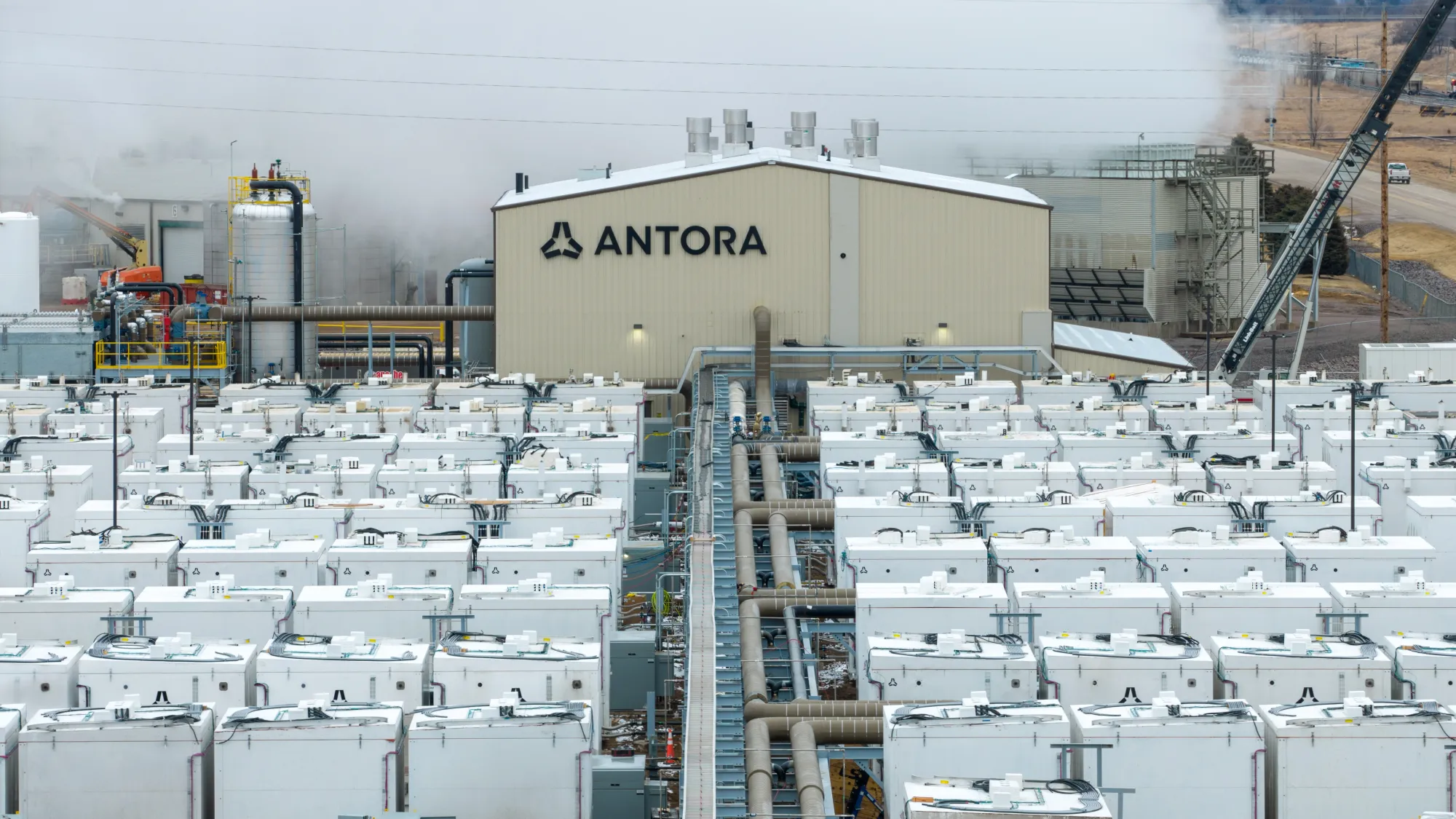
POET, the world’s largest biofuels producer, and Antora Energy have announced the commissioning of a 5 gigawatt-hour (GWh) thermal energy storage system at POET’s bioprocessing facility in Big Stone City, South Dakota. The project, which uses solid carbon blocks to store energy as heat, is designed to provide firm, around-the-clock energy to industrial operations.
The Update
The project involves the deployment of over 200 of Antora’s thermal batteries. Construction to energy delivery was achieved in under 12 months, with the system expected to be fully operational later this year. Once complete, the 5 GWh facility will rank among the largest energy storage projects by capacity globally.
Antora’s technology stores low-cost electricity as heat in insulated blocks of solid carbon. This stored energy is delivered to POET under a long-term heat offtake agreement, providing the bioprocessing plant with a consistent energy supply to support bioethanol production. The project was financed by Grok Ventures, serving as the sole external project-level investor.
Infrastructure Context
The deployment relies on a specialized electric rate developed in coordination with Otter Tail Power and approved by the South Dakota Public Utilities Commission in 2023. This rate structure allows the thermal batteries to charge during periods of surplus local energy production. By absorbing excess power when grid demand is low or generation is high, the system utilizes existing grid infrastructure without increasing costs for other utility customers.
The hardware is manufactured at Antora’s gigafactory in San Jose, California. Unlike lithium-ion systems, these thermal batteries utilize carbon blocks rather than supply-constrained critical minerals, drawing on domestic supply chains across 12 states.
Market Signal
This commissioning signals a shift toward multi-day thermal storage as a viable solution for heavy industry. For POET, the integration of thermal batteries is expected to lower energy costs and increase production efficiency, which the company claims will create tens of millions of dollars in annual market opportunities for regional farmers.
The project also highlights the role of public-private lifecycles in energy technology. Antora’s core technology received early R&D funding from the U.S. Department of Energy during the first Trump Administration, which subsequently catalyzed hundreds of millions in private capital from investors including BlackRock, Temasek, and NextEra Energy Resources.
Execution Questions
While the rapid 12-month construction timeline suggests high modularity and readiness, the long-term operational performance of a 5 GWh carbon-block system in a commercial industrial setting remains to be fully observed. The success of the "heat offtake" model will depend on the system’s ability to maintain thermal discharge rates that match the high-pressure requirements of bioprocessing. Furthermore, the scalability of this model to other regions will depend on the willingness of state regulators to approve similar "flexible load" utility rates.
Key Takeaways
- Capacity and Speed: The 5 GWh project moved from construction to energy delivery in less than a year, demonstrating rapid deployment capabilities for large-scale thermal storage.
- Grid Integration: An innovative rate agreement with Otter Tail Power enables the system to charge during surplus production, optimizing grid utilization.
- Supply Chain Resilience: The technology uses solid carbon blocks instead of critical minerals, mitigating risks associated with international battery material markets.
EnergyInsyte's Take
For energy executives and industrial buyers, the Big Stone City project is a significant test case for "decoupling" industrial heat from natural gas volatility. By converting intermittent electricity into firm industrial heat, POET is effectively using the grid as a fuel source. Decision-makers should watch the final operational data later this year to see if the system meets its "multi-day" discharge claims under load. If the economics of the heat offtake agreement prove superior to traditional boiler fuel, this modular carbon-block approach could become a standard blueprint for decarbonizing steam-heavy industries and providing firming capacity for data centers.
Source: Businesswire