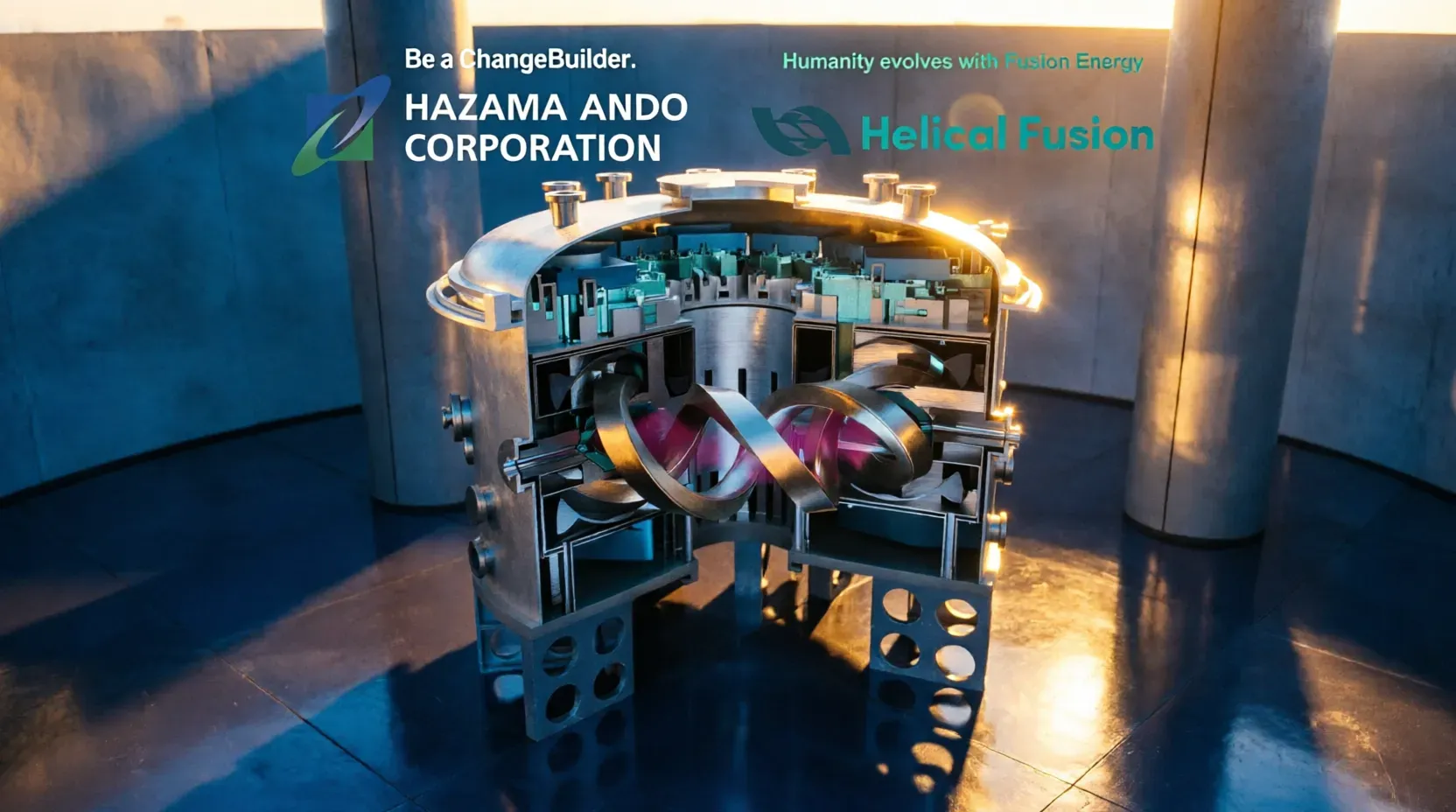
HAZAMA ANDO CORPORATION announced it has become an Official Partner in Helical Fusion Co., Ltd.’s commercial fusion initiative, the Helix Program. The two firms also signed a memorandum of understanding (MoU) to collaborate on the design and construction of Helix KANATA, a fusion pilot plant slated for the 2030s. The partnership brings a seasoned Japanese general contractor into the early‑stage engineering and construction phase of private fusion development, a sector where industrial execution capability is a critical bottleneck.
HAZAMA ANDO Becomes Official Partner in the Helix Program
Helical Fusion, a Japan‑based startup focused on the Helical Stellarator magnetic‑confinement concept, formalized the Official Partner framework in April 2026 to accelerate its roadmap toward commercially viable fusion power. In the announcement, HAZAMA ANDO was named the latest Official Partner, joining the Helix Program’s effort to move core technologies from laboratory research to integrated engineering and construction.
The MoU outlines joint work on construction‑related requirements and project‑execution approaches for future fusion facilities, beginning with Helix KANATA. HAZAMA ANDO’s President Kazuhiko Kuniya said the firm will “leverage the expertise and technology we have cultivated over the years to contribute to the realization of fusion energy.” Helical Fusion CEO Takaya Taguchi added that the partnership will help advance both the Integrated Demonstration Device, Helix HARUKA, and the pilot plant, Helix KANATA.
Construction Expertise Applied to Fusion Pilot Plant Development
HAZAMA ANDO has a long history of delivering power‑related infrastructure and other social‑utility projects that support stable electricity supply. Through the MoU, the contractor will examine the specific construction challenges of a fusion power facility, including large‑scale magnetic systems, high‑heat‑flux components, and continuous‑operation requirements unique to the Helical Stellarator design.
The Helix KANATA pilot plant is positioned as the first step toward commercial fusion power generation in the 2030s. While the announcement does not disclose detailed engineering schedules or budget figures, it signals that industrial partners are being engaged early to shape the plant’s build‑out strategy. Helical Fusion’s roadmap also includes Helix HARUKA, an Integrated Demonstration Device whose key components are already progressing with support from other industrial partners.
Private Fusion Roadmap Signals Growing Industry Momentum
Helical Fusion’s Helix Program is one of the few private‑sector efforts that directly applies the roughly 70‑year research base of the Helical Stellarator to commercial‑scale power generation. In May 2023 the company published a peer‑reviewed paper, “Development of steady‑state fusion reactor by Helical Fusion,” outlining its plant concept. The program’s timeline—demonstration with Helix HARUKA followed by pilot‑plant operation with Helix KANATA in the 2030s—places it within the broader decade‑long window when many private fusion ventures expect to transition from R&D to integrated engineering.
The addition of a major construction firm as an Official Partner underscores the growing recognition that fusion’s path to market will require not only scientific breakthroughs but also proven industrial execution capabilities. By formalizing collaboration through an MoU, Helical Fusion is building an industrial supply chain that could reduce the schedule risk associated with building the first commercial‑scale fusion plant.
Key Takeaways
- HAZAMA ANDO became an Official Partner in Helical Fusion’s Helix Program and signed an MoU to work on the Helix KANATA fusion pilot plant targeted for the 2030s.
- The Helix Program, established in April 2026, aims to move from integrated demonstration with Helix HARUKA to commercially viable power generation with Helix KANATA.
- Helical Fusion’s Helical Stellarator approach is supported by about 70 years of university and public‑research research and was detailed in a peer‑reviewed paper published in May 2023.
EnergyInsyte's Take
The partnership adds credible construction expertise to a private fusion effort that is still in the early engineering phase, suggesting that industrial readiness is becoming a priority for developers. However, detailed timelines, cost estimates, and regulatory pathways remain undisclosed, leaving execution risk largely unquantified. Energy executives should monitor how the Helix KANATA design matures and whether additional construction partners are enlisted as the project moves toward the 2030s.
Source: Businesswire