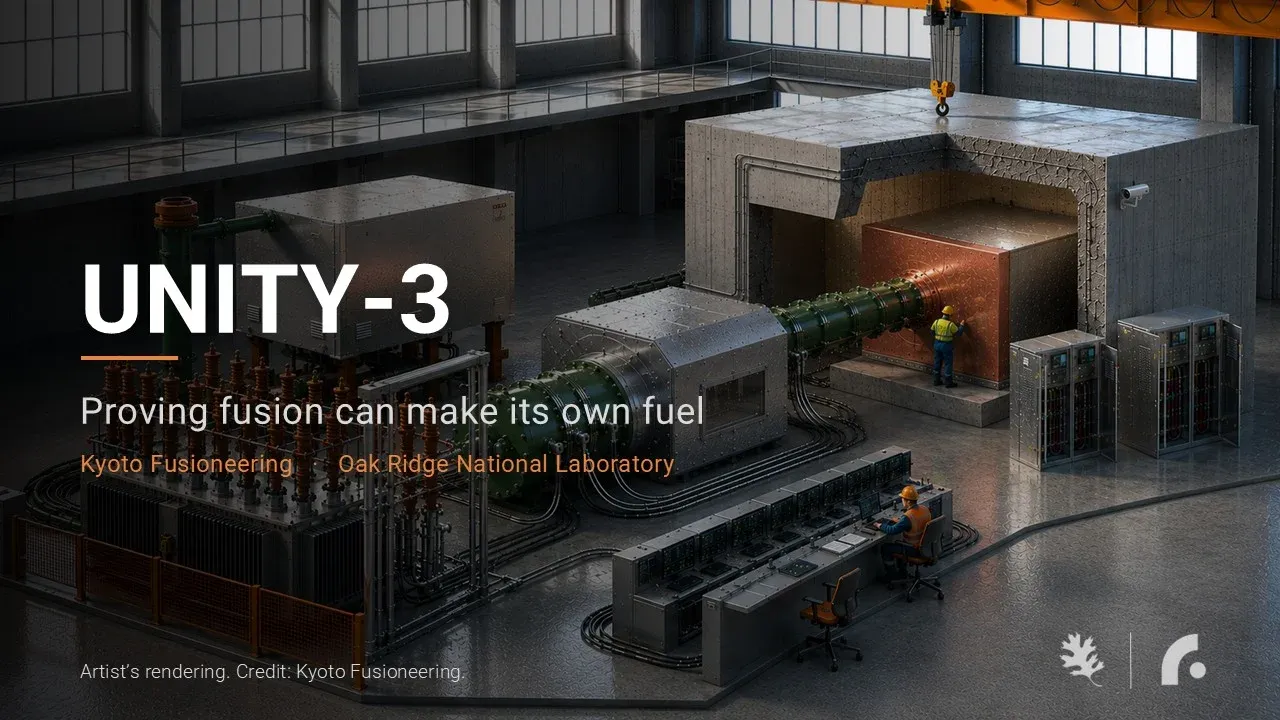
Kyoto Fusioneering (KF) is relocating its United States headquarters to Oak Ridge, Tennessee, to spearhead the development of UNITY-3, a first-of-its-kind facility designed to validate tritium breeding blanket technology. Developed in partnership with Oak Ridge National Laboratory (ORNL), this project addresses a critical national priority identified in the U.S. Department of Energy's (DOE) Fusion Science & Technology Roadmap. By establishing this shared infrastructure, KF aims to de-risk the fuel cycle for the entire fusion sector, providing the essential testing capabilities required to transition from experimental physics to commercial power plants. Supported by the Tennessee Nuclear Energy Supply Chain Investment Fund and the DOE, the move integrates Japan's specialized fusion engineering heritage with America's established nuclear innovation ecosystem to accelerate the global commercialization of fusion energy.
Kyoto Fusioneering Relocates to Oak Ridge for UNITY-3
Kyoto Fusioneering has announced a strategic relocation of its U.S. headquarters to Oak Ridge, Tennessee, to facilitate the construction of UNITY-3 alongside Oak Ridge National Laboratory. This facility is specifically engineered to validate tritium breeding blanket technology, a component essential for any commercial deuterium-tritium (D-T) fusion power plant. Because tritium is not found in significant quantities in nature, future plants must "breed" their own fuel within a lithium-bearing shell. Currently, blanket and fuel cycle technologies are among the least mature systems in the fusion industry, representing a significant gating risk for commercialization.
The UNITY-3 project is being delivered through a public-private partnership, receiving funding from the U.S. Department of Energy and support from the State of Tennessee via its Nuclear Energy Supply Chain Investment Fund. The facility will utilize an accelerator-based volumetric D-T fusion neutron source to measure neutron spectrum and tritium production in neutronically prototypic blankets. This capability allows for the benchmarking and de-risking of simulation codes used by the industry to design power plants. Notably, no other existing or planned facility offers this specific combination of source geometry, test-article scale, and depth-resolved measurement capability.
By locating in East Tennessee, KF intends to leverage the region's deep concentration of nuclear expertise, skilled technical workforce, and established supply chains. The company plans to manufacture hardware, components, and engineering services locally, creating a physical anchor for an allied fusion supply chain. This move is intended to bridge Japan’s decades of specialized fusion engineering with the premier nuclear innovation ecosystem found at ORNL, effectively addressing one of the industry's most difficult engineering challenges: how breeding blankets perform in real nuclear environments.
De-risking the Fusion Fuel Cycle via UNITY Program
The UNITY-3 facility serves as a critical component of the broader UNITY™ (Unique Integrated Testing Facility) Program, a staged approach to de-risking the fusion fuel cycle by isolating distinct physics challenges. The program is structured to address different categories of risk through separate-effects testing before full-scale integration. UNITY-1, currently operating in Kyoto, Japan, focuses on the non-nuclear behavior of liquid-metal breeding blankets, including thermal-hydraulics and materials compatibility. UNITY-2, being developed in Ontario through a joint venture with Canadian Nuclear Laboratories, aims to demonstrate the first continuous, end-to-end D-T fuel cycle in power-plant-relevant conditions.
UNITY-3 adds the essential nuclear dimension to this progression, focusing on neutronics, tritium production validation, and transmutation effects that require a real fusion-neutron environment. Beyond physical testing, UNITY-3 is positioned to support the DOE’s Genesis Mission by providing high-fidelity data for the AI-Fusion Digital Convergence Platform (DCP). The measurements captured at the facility—data that has never been captured before—will be used to train and validate the digital tools and predictive simulations that are central to the DOE's vision for AI-accelerated science.
This infrastructure is designed to be "confinement-agnostic," meaning it can serve the entire fusion sector regardless of the specific plasma confinement approach a developer uses. By providing an open testing ground, KF and ORNL aim to prevent individual fusion companies from having to absorb the immense costs and technical risks of vertical integration. This allows developers to focus their capital on plasma confinement while relying on UNITY-3 to mature the foundational blanket and fuel cycle systems required for commercial viability.
Key Takeaways
- UNITY-3 will utilize an accelerator-based volumetric D-T fusion neutron source to validate tritium breeding blanket performance through neutron spectrum and tritium production measurements.
- The project is supported by the U.S. Department of Energy and the Tennessee Nuclear Energy Supply Chain Investment Fund, marking a public-private partnership to address the DOE's Fusion Science & Technology Roadmap.
- The UNITY Program follows a staged de-risking model, with UNITY-1 in Japan addressing non-nuclear behaviors and UNITY-2 in Canada focusing on end-to-end D-T fuel cycles.
EnergyInsyte's Take
In our view, the establishment of UNITY-3 represents a fundamental shift in the fusion industry from theoretical physics toward industrial engineering. For years, the sector has seen massive capital inflows—exceeding $12 billion globally—yet these investments have largely been concentrated on plasma confinement. This has created a dangerous imbalance where the "engine" of the fusion plant is being developed while the "fuel system" remains unproven. By creating confinement-agnostic, shared infrastructure, Kyoto Fusioneering and ORNL are effectively addressing a systemic market failure: the lack of standardized testing environments for critical components.
This move signals that the fusion industry is entering a phase of maturity where the focus is shifting toward reliability and supply chain integration. The decision to locate in Oak Ridge is a strategic play to tap into a pre-existing nuclear ecosystem, reducing the time-to-market for essential hardware. For B2B decision-makers and investors, the success of UNITY-3 will be a primary indicator of whether fusion can move beyond the laboratory and into the realm of predictable, scalable, and bankable power generation.
Questions & Answers
How does UNITY-3 mitigate the "gating risk" for fusion developers?
UNITY-3 provides a specialized testing environment to validate tritium breeding blankets, which are essential for fuel self-sufficiency. By offering a confinement-agnostic facility that uses a D-T neutron source to measure tritium production and neutronics, it allows developers to test their designs without the massive capital expenditure required to build their own integrated testing infrastructure.
What role does UNITY-3 play in the U.S. Department of Energy's broader digital strategy?
The facility will act as a foundational data source for the AI-Fusion Digital Convergence Platform (DCP), a flagship challenge of the DOE Genesis Mission. The high-fidelity, unprecedented measurements of fusion neutronics and tritium production generated at UNITY-3 will be used to train and validate the AI-driven predictive simulation tools necessary to compress the timeline to commercial fusion.
Why is the relocation to Tennessee strategically significant for the fusion supply chain?
The relocation to Oak Ridge places Kyoto Fusioneering within a premier nuclear innovation ecosystem characterized by a deep concentration of expertise, a skilled workforce, and an established supply chain. This enables KF to build an allied fusion supply chain locally, manufacturing hardware and components in a region that already supports the broader nuclear resurgence.
How does the UNITY Program approach the complexity of fusion fuel cycles?
The program uses a staged, "separate-effects" testing methodology to isolate and resolve specific risks. UNITY-1 handles non-nuclear thermal and material behaviors; UNITY-2 focuses on end-to-end fuel cycle demonstration; and UNITY-3 addresses the critical nuclear dimension of neutronics and tritium production, ensuring each layer of complexity is validated before full-scale integration.
Source: BUSINESSWIRE