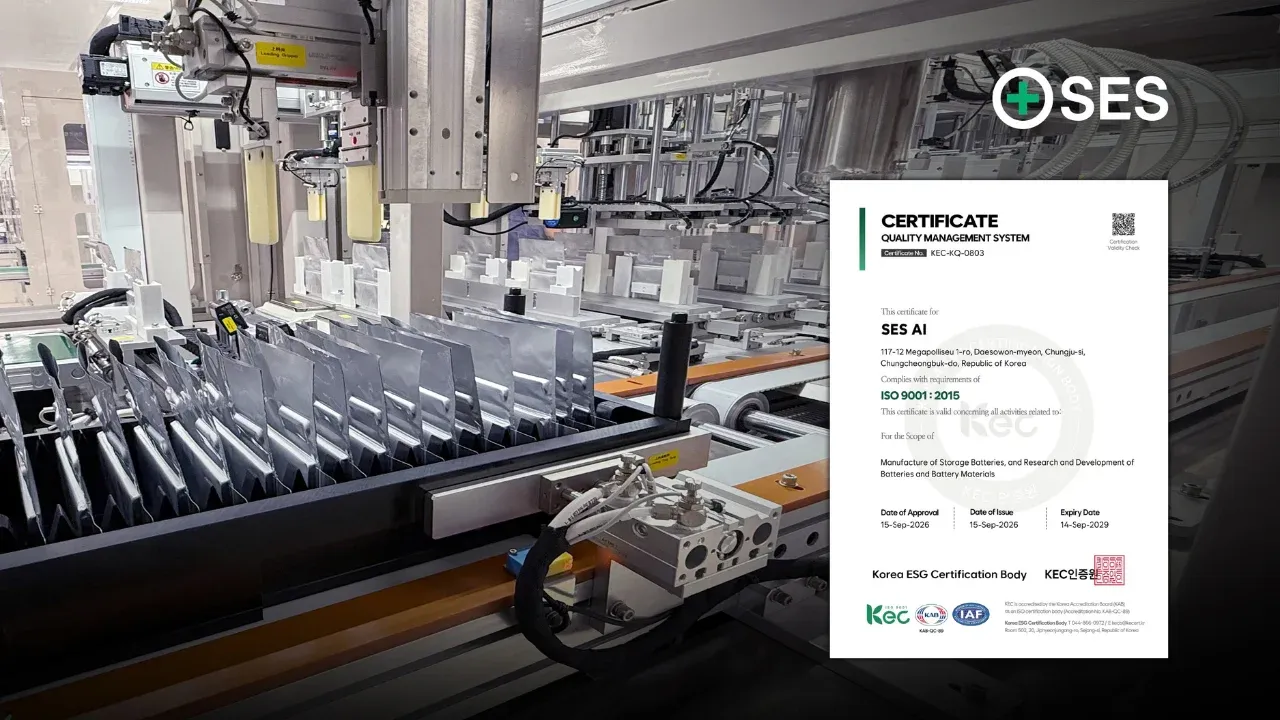
SES AI is positioning its South Korean manufacturing operations to capture a larger share of the global drone market by aligning its production standards with international quality and security requirements. The company announced that its Chungju facility has achieved ISO 9001:2015 certification for its quality management system, a move intended to bolster its ability to supply high-performance Li-Metal and Li-ion pouch cells. This certification follows the company's recent scale-up to an annual production capacity of approximately one million cells. By securing this standardized framework, SES AI aims to address the specific requirements of drone operators who prioritize manufacturing traceability, consistency, and secure supply chains, particularly those operating within the United States and other highly regulated international markets.
Scaling Production and Quality Standards in Chungju
The achievement of ISO 9001:2015 certification by the Korea ESG Certification Body marks a transition for SES AI from specialty production toward a more industrial-scale supply chain. The certification specifically covers the manufacture of storage batteries as well as the research and development of batteries and battery materials. This standardized framework is intended to govern critical manufacturing stages, including incoming material control, cell manufacturing, inspection, testing, and traceability. For the company, this represents a formalization of the processes required to manage its expanded capacity, which has recently reached approximately one million Li-Metal and Li-ion pouch cells per year.
As the drone industry moves toward higher volumes, SES AI is leveraging this certification to argue that its Chungju facility can meet the rigorous demands of mission-critical applications. The company is focusing on cells that combine high energy density with high power density, specifically targeting drone missions where payload capacity and flight time are constrained by battery weight. By implementing these standardized quality management processes, SES AI is attempting to provide the dependability required by commercial and industrial drone customers who cannot afford the risks associated with inconsistent cell performance or unverified manufacturing origins.
Navigating Export Controls and NDAA Compliance
SES AI is heavily linking its manufacturing location in South Korea to recent shifts in international trade and security regulations. The company is positioning its Chungju-produced cells as NDAA-compliant, a critical factor for customers in the United States seeking to avoid supply chain vulnerabilities. This compliance strategy is being reinforced by a recent regulatory change in South Korea, where the government raised the export control energy density threshold for secondary batteries to 500Wh/kg. This stands in contrast to the 350Wh/kg threshold maintained by most other countries, a move that SES AI suggests creates more favorable trading logistics and compliance conditions for Korean-made cells.
By manufacturing in South Korea and adhering to these updated standards, SES AI is attempting to navigate the complex intersection of high-performance energy requirements and geopolitical security mandates. The company's focus on both Li-Metal and advanced Li-ion pouch cells allows it to target a spectrum of high-performance mobility applications. The combination of increased export thresholds and the ability to provide NDAA-compliant sourcing gives the company a strategic opening to export high-density cells to markets that are increasingly sensitive to the origin and security of their energy storage components.
Key Takeaways
- SES AI’s Chungju facility has achieved ISO 9001:2015 certification for battery manufacture and R&D.
- The company has scaled its annual production capacity to approximately one million Li-Metal and Li-ion pouch cells.
- South Korea has raised its export control energy density threshold for secondary batteries to 500Wh/kg, exceeding the 350Wh/kg standard used by most other nations.
EnergyInsyte's Take
In our view, SES AI is executing a calculated dual-track strategy: scaling industrial capacity while simultaneously weaponizing regulatory shifts to create a competitive moat. The move to achieve ISO 9001:2015 certification is not merely a quality upgrade; it is a prerequisite for entry into the high-stakes defense and industrial drone sectors where traceability is non-negotiable. Furthermore, by highlighting the discrepancy between South Korea’s 500Wh/kg export threshold and the global 350Wh/kg norm, SES AI is signaling to the market that its Korean-based production offers a regulatory "fast lane" for high-density energy products. This suggests the company is less focused on general consumer markets and more on high-margin, high-security niches where NDAA compliance and energy density are the primary drivers of procurement decisions.
Questions & Answers
How does the ISO 9001:2015 certification impact SES AI's ability to serve the drone market?
The certification establishes a standardized quality management framework covering material control, manufacturing, testing, and traceability. This is intended to provide the consistency and dependability required by drone customers who prioritize high energy density alongside rigorous manufacturing quality.
What role does South Korean export policy play in SES AI's competitive positioning?
The South Korean government raised the export control energy density threshold for secondary batteries to 500Wh/kg, while most other countries remain at 350Wh/kg. SES AI suggests this makes trading logistics and compliance more favorable for its Korean-produced cells.
What is the current production scale of the Chungju facility?
SES AI has recently completed a scale-up to an annual production capacity of approximately one million Li-Metal and Li-ion pouch cells.
Why is NDAA compliance a critical factor for SES AI's target customers?
The company is positioning its Chungju-manufactured cells as NDAA-compliant to serve customers, particularly in the United States, who require secure, dependable, and regulated battery supply chains for their drone and mobility applications.
Source: SES