Argonne National Laboratory is investigating how passive safety mechanisms can manage decay heat in next-generation nuclear reactors. By studying natural convection, researchers aim to ensure heat removal during unplanned shutdowns without relying on mechanical pumps or active controls. This research, supported by the U.S. Department of Energy, focuses on the Reactor Cavity Cooling System (RCCS) to enhance safety in advanced reactor designs.
Argonne NSTF Decay Heat Research
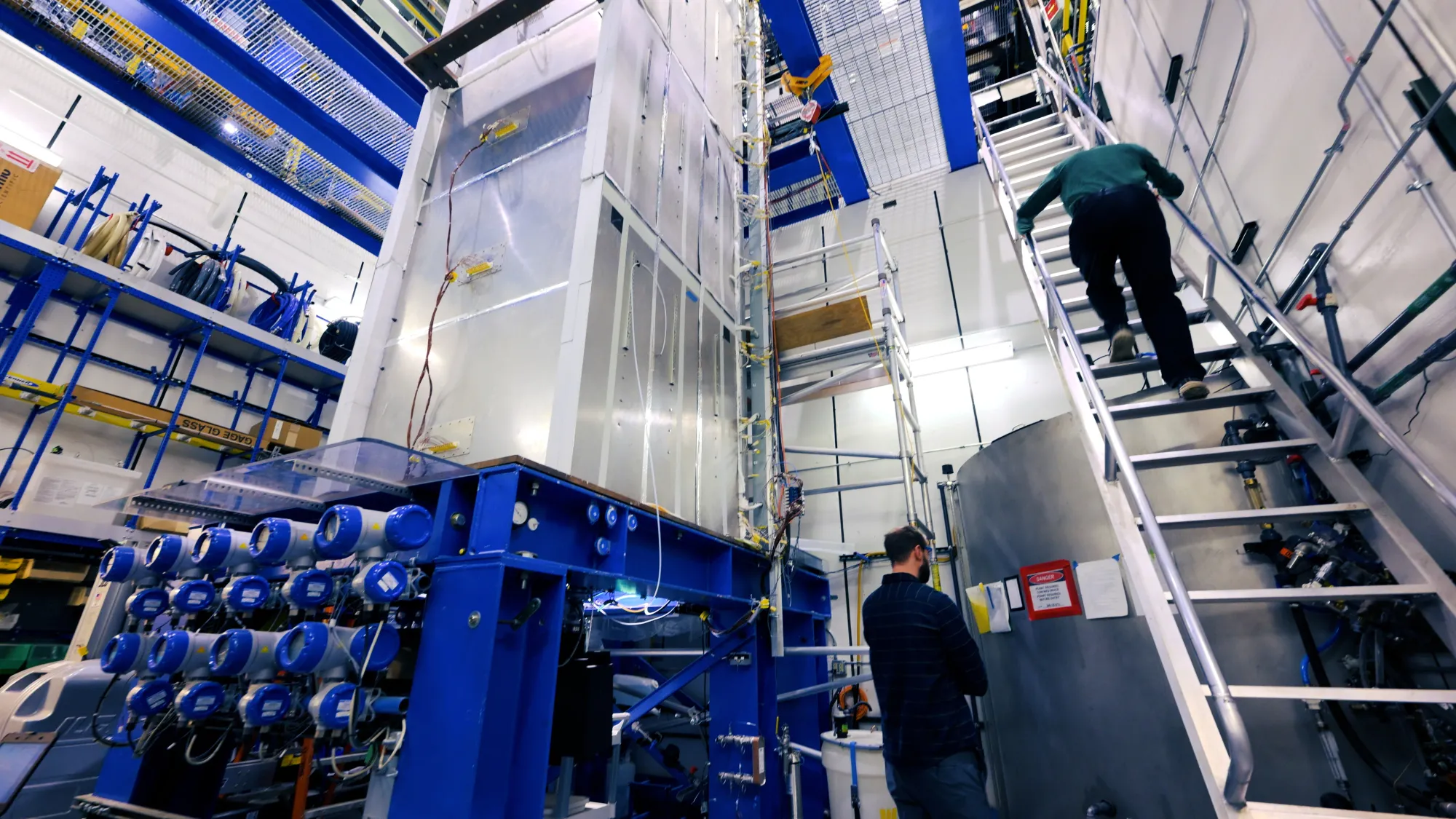
Researchers utilized the 59-foot-tall Natural Convection Shutdown Heat Removal Test Facility (NSTF) to simulate realistic decay heat conditions. The study examined the Reactor Cavity Cooling System (RCCS), a concept that uses gravity and buoyancy to move water through metal tubes surrounding a reactor vessel. When a reactor shuts down, heat transfers to these tubes, causing warmer water to rise and cooler water to fall toward a high-elevation storage tank. The team specifically analyzed how the system behaves when liquid water and steam coexist. By scaling power levels and adjusting the height of the main water tank inlet, the Argonne team observed how different configurations influence fluid circulation and the potential for "flashing"—a phenomenon where water suddenly turns to steam, potentially causing flow surges and component stress.
Implications for Advanced Reactor Design
The findings provide critical data for companies developing advanced nuclear technologies. A primary discovery involved how decay heat levels at lower power influence the spread of boiling and flashing from the NSTF tank into its chimney. Furthermore, the researchers identified that the height of the tank inlet significantly impacts stability; they concluded that mid-level inlets contributed to more stable operating conditions in specific scenarios. Understanding these boundaries is essential for engineers to prevent flashing-induced surges that could reduce cooling efficiency or stress reactor components. As the industry moves toward decentralized or modular reactor designs, the ability to predict these passive thermal-hydraulic behaviors becomes a prerequisite for regulatory approval and operational reliability in next-generation nuclear infrastructure.
Key Takeaways
- Argonne researchers used a 59-foot-tall loop at the NSTF to study natural convection cooling.
- The study identified "flashing" as a risk where water suddenly turns to steam, potentially stressing reactor components.
- Results suggest that mid-level tank inlets may provide more stable operating conditions for the RCCS.
EnergyInsyte's Take
In our view, this research highlights the technical hurdles remaining in the deployment of passive safety systems for advanced reactors. While removing mechanical pumps reduces complexity, it introduces unpredictable fluid dynamics like "flashing" that require precise engineering. For developers, the Argonne findings suggest that reactor geometry—specifically inlet placement—is not a secondary detail but a primary driver of thermal stability. Success in the advanced nuclear market will likely depend on how effectively companies can integrate these natural convection findings into standardized, scalable reactor architectures.
Questions & Answers
How does the RCCS concept eliminate the need for active mechanical pumps?
The Reactor Cavity Cooling System relies on natural phenomena, specifically gravity and buoyancy, to circulate water through metal tubes. As decay heat warms the water, it rises naturally, creating a continuous loop that moves heat to a higher-elevation storage tank without requiring external power or mechanical intervention.
What is the strategic risk associated with the "flashing" phenomenon?
Flashing occurs when water reaches a critical point and suddenly converts to steam. For reactor operators, this creates surges in the flow of water and steam, which can reduce overall cooling efficiency and place unexpected mechanical stress on critical reactor components during a shutdown.
Why is the height of the water tank inlet a critical design variable?
The height of the inlet dictates the volume of available water and influences how fluid circulates through the loop. Argonne's testing identified a specific boundary where inlet height changes operating metrics, suggesting that mid-level inlets may offer the most stable conditions for managing decay heat.
What role does the NSTF play in advanced nuclear development?
The Natural Convection Shutdown Heat Removal Test Facility serves as a large-scale experimental environment that allows researchers to test cooling systems at realistic sizes and conditions. This enables the observation of complex thermal-hydraulic behaviors, such as boiling and flashing, before they are implemented in full-scale commercial reactors.
Source: Argonne