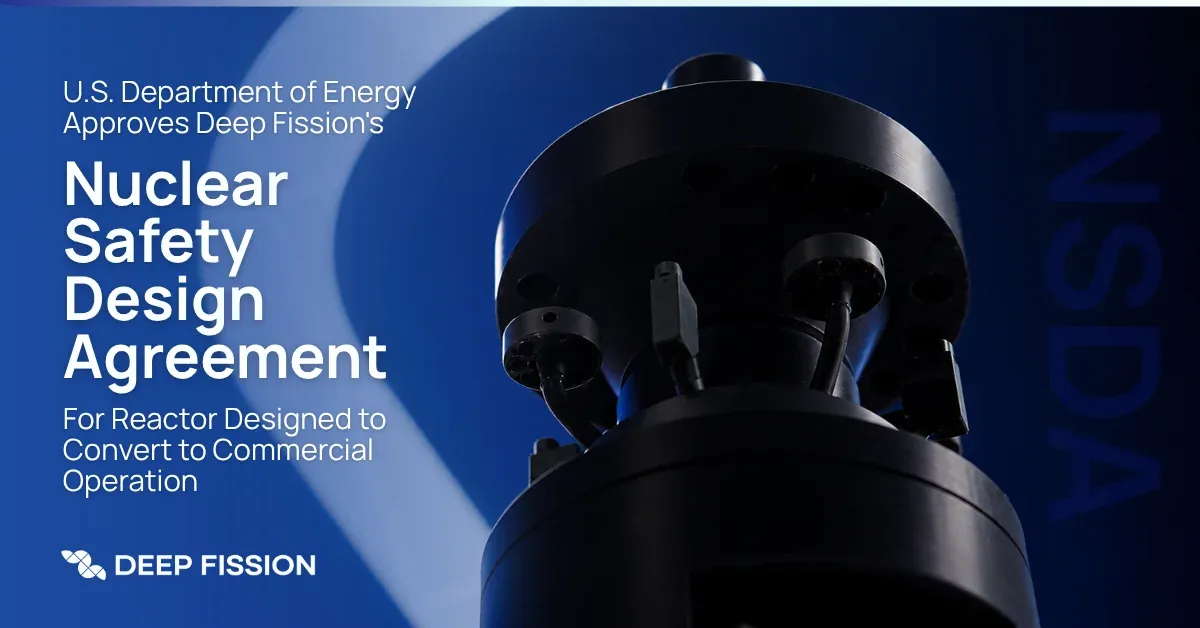
The U.S. Department of Energy (DOE) has approved the Nuclear Safety Design Agreement (NSDA) for Deep Fission’s Gravity™ Nuclear Reactor. This regulatory milestone confirms the design warrants advancement under the DOE’s Reactor Pilot Program. The approval establishes the safety framework necessary for the company to move toward the demonstration and eventual deployment of its unique underground reactor technology.
DOE NSDA Approval for Gravity™ Reactor
The approval of the NSDA marks a critical regulatory transition for Deep Fission, moving the company into the next phase of the DOE authorization pathway. This agreement provides the safety framework required to guide the continued development of the Gravity™ reactor, which utilizes small modular pressurized water reactors installed one mile underground. CEO Liz Muller noted that the mile-deep design is intended to facilitate faster progress in upcoming development stages. By securing this framework, Deep Fission positions its technology to advance through subsequent stages of review and authorization under the federal Reactor Pilot Program, maintaining a structured path toward full-scale demonstration and eventual commercial operation.
Parsons, Kansas Pilot Project Progress
Deep Fission is actively advancing its commercial pilot project located at the Great Plains Industrial Park in Parsons, Kansas. Since breaking ground in December 2025, the company has successfully drilled its first data acquisition well to a depth of 6,000 feet and delivered a prototype reactor canister to the site. The current proof-of-concept program involves large-diameter well drilling and prototype installation milestones. Crucially, the Parsons project is not a single criticality test; the company intends for this demonstration reactor to transition into a fully Nuclear Regulatory Commission-licensed, commercially operating unit that delivers power following initial testing and DOE authorization.
Key Takeaways
- The DOE approved the Nuclear Safety Design Agreement (NSDA) for the Gravity™ reactor.
- Deep Fission has drilled a 6,000-foot data acquisition well at its Parsons, Kansas site.
- The Parsons demonstration reactor is intended to become a licensed, commercially operating unit.
EnergyInsyte's Take
In our view, this NSDA approval signals a significant shift toward integrating advanced nuclear technology into deep-subsurface infrastructure. By securing a safety framework early, Deep Fission is attempting to de-risk the regulatory pathway for underground deployment. The commitment to transitioning the Parsons pilot into a licensed commercial unit, rather than a mere test, suggests a strategic focus on long-term capital deployment and grid-scale reliability rather than short-term experimental validation.
Questions & Answers
How does the NSDA approval impact the development timeline for the Gravity™ reactor?
The approval establishes the essential safety framework required to advance through the DOE’s Reactor Pilot Program, moving the company from design validation toward demonstration and commercial deployment.
What is the current physical progress at the Parsons, Kansas site?
Deep Fission has broken ground, drilled a 6,000-foot data acquisition well, and delivered a prototype reactor canister to the Great Plains Industrial Park.
Is the Parsons project intended for experimental testing only?
No. The company intends for the demonstration reactor to become a fully Nuclear Regulatory Commission-licensed, commercially operating unit that delivers power.
What is the core technical differentiator of the Deep Fission design?
The Gravity™ reactor utilizes small modular pressurized water reactors specifically designed to be installed one mile underground.
Source: BUSINESSWIRE