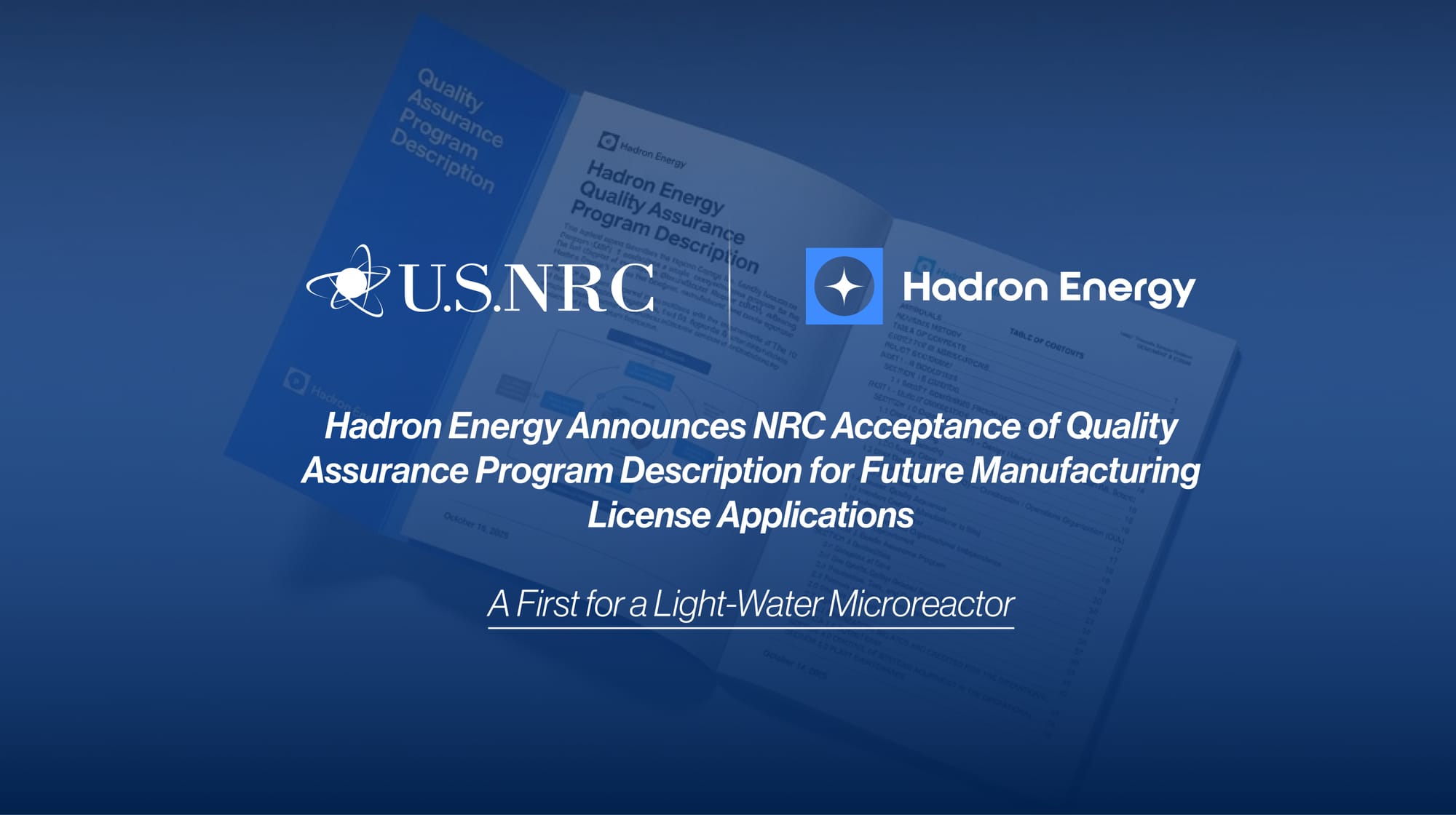
Hadron Energy, Inc. (Nasdaq: HDRN) announced that the staff of the U.S. Nuclear Regulatory Commission (NRC) has issued a final safety‑evaluation finding that Revision 3 of the company’s Topical Report “Hadron Energy, Inc. Quality Assurance Program Description” (QAPD) is acceptable for reference in future licensing applications under 10 CFR Part 52. This acceptance confirms that the QAPD meets the NRC’s regulatory requirements and the industry’s most recent quality‑assurance standards, specifically Appendix B to 10 CFR Part 50 and ASME NQA‑1‑2022 as endorsed by NRC Regulatory Guide 1.28, Rev. 6. It also marks the first time a light‑water micro‑reactor developer has received formal NRC acknowledgment of a quality‑assurance program, giving Hadron Energy a vetted, lifecycle‑wide framework that covers design, manufacturing, construction, operation, and decommissioning of its Hadron Micro‑Modular Reactor.
Hadron Energy Receives NRC Acceptance of QAPD
The NRC staff concluded that Hadron Energy’s QAPD complies with applicable NRC regulations and industry standards, specifically Appendix B to 10 CFR Part 50 and ASME NQA‑1‑2022 as endorsed by NRC Regulatory Guide 1.28, Rev. 6. The acceptance does not constitute a construction or operating license, nor does it represent NRC review, approval, or certification of the reactor design itself. Rather, it establishes a programmatic regulatory milestone that allows Hadron Energy to cite the accepted QAPD in future licensing submissions, potentially reducing duplicate review of previously accepted material. The company must publish the accepted Topical Report within three months of NRC notification, adding the “‑A” suffix to indicate official acceptance.
Regulatory Context and Licensing Implications
Under 10 CFR Part 52, applicants may seek a Combined License (COL) or a Manufacturing License that integrates design certification and construction approval. By securing NRC acceptance of its QAPD, Hadron Energy can reference the program in such applications, subject to the limitations and conditions outlined in the safety evaluation. The NRC staff’s request for public release of the accepted report aligns with standard practice, ensuring transparency and providing a reference point for other stakeholders. The acceptance also signals that Hadron Energy’s quality‑assurance framework meets the graded, lifecycle‑wide approach required for nuclear safety, where control levels correspond to the safety significance of items or activities. Because the QAPD is now an “‑A”‑designated document, future license applicants—whether Hadron or other firms—can rely on its vetted content, avoiding repetitive NRC review of the same quality‑assurance material and thereby streamlining the overall licensing timeline.
Potential Impact on Microreactor Development
Hadron Energy’s QAPD covers the full lifecycle of its Micro‑Modular Reactor, positioning the company to advance its licensing strategy with a documented, NRC‑vetted quality foundation. Founder and CEO Sam Gibson noted that the acceptance “provides a vetted foundation that we can reference as we advance our licensing strategy, helping reduce duplicative review of previously accepted material in future applications.” While the acceptance does not guarantee future license approval, it may streamline the regulatory path for the first‑of‑a‑kind deployment of the Hadron Micro‑Modular Reactor by eliminating the need to re‑submit the same quality‑assurance documentation. The milestone also establishes Hadron Energy as the first light‑water microreactor firm to achieve this level of NRC acknowledgment, potentially influencing how other small‑modular reactor developers structure their quality programs. By demonstrating compliance with ASME NQA‑1‑2022 and the graded, lifecycle‑wide control philosophy, Hadron sets a benchmark that could accelerate industry‑wide confidence in microreactor safety and expedite future public‑release requirements.
Key Takeaways
- The NRC staff found Revision 3 of Hadron Energy’s Quality Assurance Program Description acceptable for referencing in future 10 CFR Part 52 licensing applications.
- Acceptance applies a graded, lifecycle‑wide quality framework that complies with Appendix B to 10 CFR Part 50 and ASME NQA‑1‑2022, and it is the first such approval for a light‑water microreactor company.
- Hadron Energy must publish the accepted Topical Report within three months, after which it may cite the QAPD in Combined License or Manufacturing License submissions, potentially reducing duplicate NRC review.
EnergyInsyte's Take
The NRC’s acceptance gives Hadron Energy a concrete regulatory foothold as it moves toward licensing its Micro‑Modular Reactor, but the company still faces the substantive design and construction reviews required for a COL or Manufacturing License. Executives should monitor the forthcoming public release of the accepted Topical Report and any subsequent NRC feedback that could affect the timing or scope of future applications.
Source: Businesswire