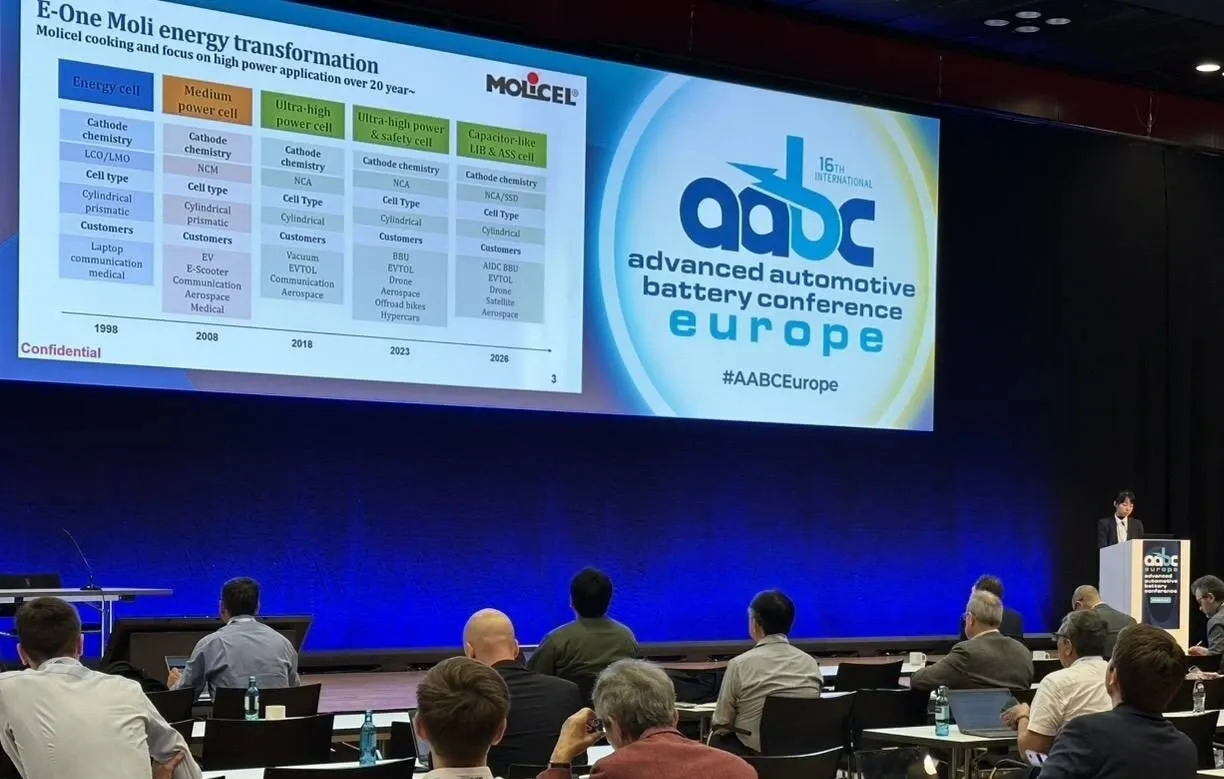
Molicel has introduced its next-generation INR-21700-P70X cell within the PX series, targeting the rapidly expanding hybrid vehicle market. Unveiled at the Advanced Automotive Battery Conference (AABC) Europe 2026, this technology aims to bridge the functional gap between traditional lithium-ion batteries and supercapacitors. By delivering high energy density alongside supercapacitor-like responsiveness, the cell addresses the specific power demands of modern hybrid powertrains. This development arrives as global automotive manufacturers shift strategic focus toward hybrid technologies to meet evolving consumer and regulatory requirements across major global markets.
Molicel PX Series Technical Specifications
The INR-21700-P70X cell is engineered to resolve the traditional trade-off between power and energy density. It features a 7000 mAh capacity and a 340 Wh/kg energy density, paired with a 30C high-rate continuous discharge capability. A critical performance metric is the cell's power switching time, which is under 200 microseconds when ramping to high-power output. This allows for a 900W peak power duration of 5 seconds, facilitating immediate current delivery for maneuvers and rapid absorption during regenerative braking.
Safety is addressed through advanced single-crystal technology, which reduces exothermal heat release by nearly 50% compared to conventional poly-crystal materials. The cell has passed the UL9540A thermal runaway evaluation, a key international safety benchmark. During abuse testing, the cells are designed to smoke rather than trigger catastrophic blowouts, effectively isolating thermal spread. Additionally, the PX series demonstrates extreme durability, retaining 96% capacity after 1,000,000 cycles under specific high-rate pulse conditions.
Global Hybrid Market Growth and Demand
The introduction of the PX series aligns with a significant tactical realignment in the global automotive industry. As battery electric vehicle (BEV) growth cools, manufacturers are prioritizing hybrid models. The International Energy Agency (IEA) notes this shift, which is reflected in regional market data. In the United States, hybrids reached nearly 20% of new vehicle sales by late 2025, while Europe saw a 24% market share according to ICCT data.
The Asia-Pacific region remains the dominant force, capturing 51.67% of the global hybrid vehicle market value across all segments, including mild, full, and plug-in hybrids. This multi-regional momentum is projected to drive the global hybrid vehicle market from USD 335.21 billion in 2026 to USD 570.78 billion by 2034. Consequently, the demand for batteries that can handle frequent, shallow power fluctuations—rather than the deep cycles typical of BEVs—is increasing, making Molicel's high-cycle, high-rate technology highly relevant for this transition.
Key Takeaways
- The INR-21700-P70X cell offers a 340 Wh/kg energy density and a 30C high-rate continuous discharge capability.
- Molicel's PX series retained 96% capacity after 1,000,000 cycles under supercapacitor-profile testing.
- The global hybrid vehicle market is projected to grow from USD 335.21 billion in 2026 to USD 570.78 billion by 2034.
EnergyInsyte's Take
In our view, Molicel’s PX series represents a strategic pivot toward the "hybridization" of energy storage requirements. By mimicking supercapacitor responsiveness while maintaining lithium-ion density, Molicel is targeting the specific high-frequency pulse demands of hybrid powertrains. This is a direct response to the market shift where hybrids, rather than pure BEVs, are capturing significant market share in the US and Europe. The ability to withstand one million cycles suggests a focus on long-term reliability and reducing manufacturer warranty risks. This technology positions Molicel to capitalize on the projected USD 570.78 billion hybrid market, moving beyond standard BEV battery chemistries.
Source: https://www.prnewswire.com/