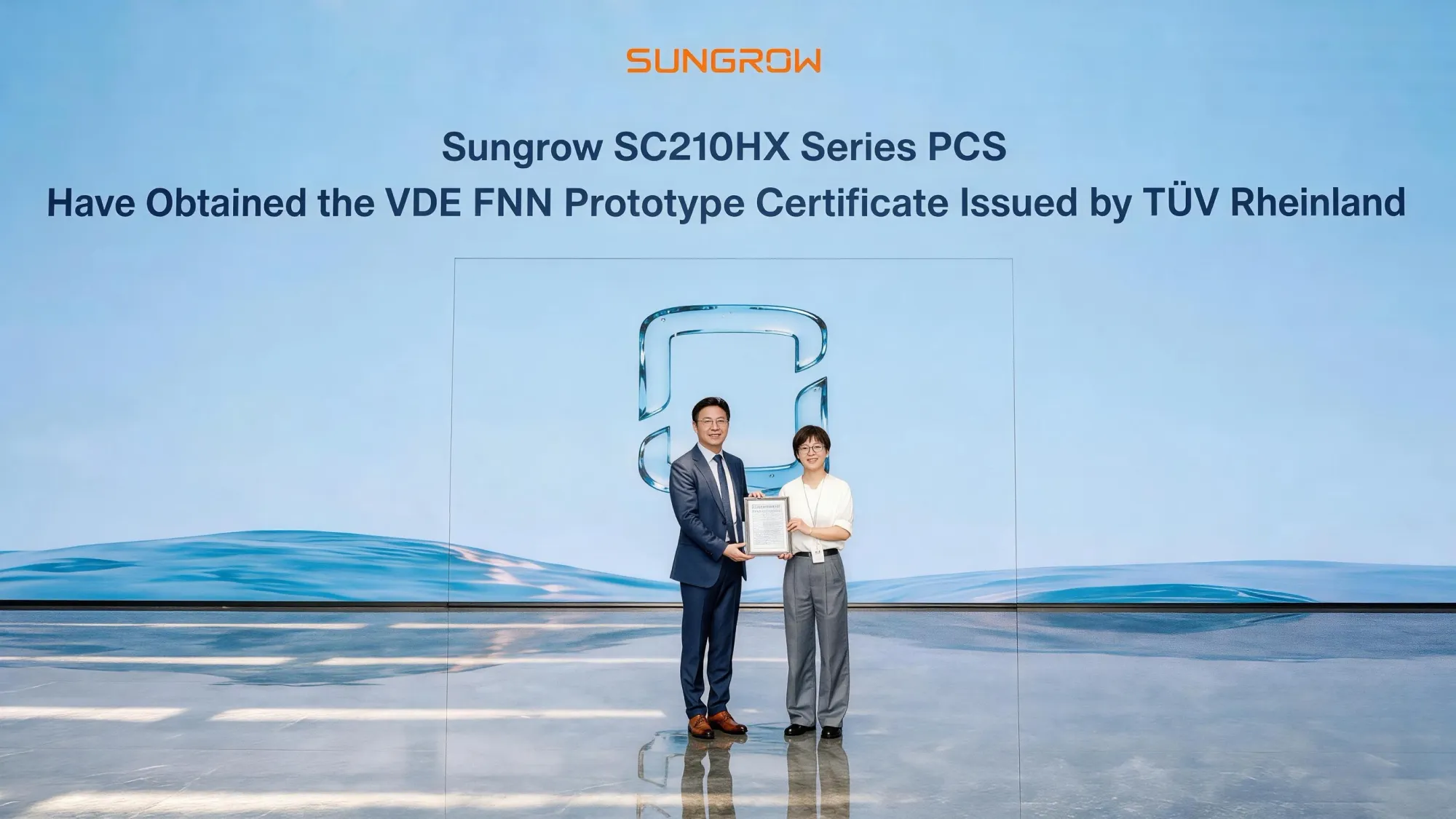
Sungrow has achieved a global milestone in grid-forming technology by securing the VDE FNN Prototype Certificate from TÜV Rheinland. Its SC210HX series Power Conversion Systems (PCS) is the first energy storage PCS to pass the complete set of German medium- and high-voltage grid connection standards. This certification includes grid-forming performance verification, positioning Sungrow to meet the evolving technical requirements of the European energy landscape.
VDE FNN Certification for SC210HX PCS
The certification, developed by VDE FNN, establishes rigorous requirements for medium- and high-voltage grid integration. This framework is a critical benchmark used by European grid operators, developers, and financial institutions to evaluate the compliance and reliability of energy storage projects. By passing these stringent tests, Sungrow has verified that its hardware reliability and proprietary control algorithms meet Germany's strictest mandatory grid standards. The SC210HX series, when integrated into PowerTitan energy storage systems, allows for faster grid connection timelines and reduces project acceptance risks. This technical validation is essential for developers seeking to navigate the increasingly complex regulatory environment and strict entry rules for Europe's emerging inertia-based energy storage markets.
Stem-Cell Grid-Forming Technology Capabilities
Utilizing proprietary Stem-Cell Grid-Forming Technology, the SC210HX series provides advanced grid adaptability and stable support. The system can independently manage active and reactive power to address frequency regulation, voltage regulation, and backup power demands. In weak grids with high renewable penetration, the converter maintains voltage-source characteristics and provides rapid dynamic reactive current during short-circuit faults. Crucially, the technology enables the establishment of a power grid without external synchronization, supporting black start and islanded operation. These features address specific grid connection challenges for remote European energy storage plants and off-grid projects. By providing these capabilities, Sungrow aims to deliver high-yield, grid-friendly solutions that enhance the overall stability and resilience of modern power infrastructures.
Key Takeaways
- Sungrow's SC210HX series is the first energy storage PCS to receive the VDE FNN Prototype Certificate from TÜV Rheinland.
- The system supports black start and islanded operation through self-developed Stem-Cell Grid-Forming Technology.
- The certification assists developers in meeting Europe's latest entry rules for the inertia market.
EnergyInsyte's Take
In our view, this certification is less about a single product and more about the commercial bankability of grid-forming assets. As European grids face higher renewable penetration, the ability to provide synthetic inertia becomes a requirement rather than an option. By securing the VDE FNN "passport," Sungrow is directly addressing the primary concerns of lenders and grid operators: technical compliance and project timelines. This move signals that the competitive frontier in energy storage has shifted from simple capacity to sophisticated, grid-stabilizing intelligence.
Source: https://www.prnewswire.com/