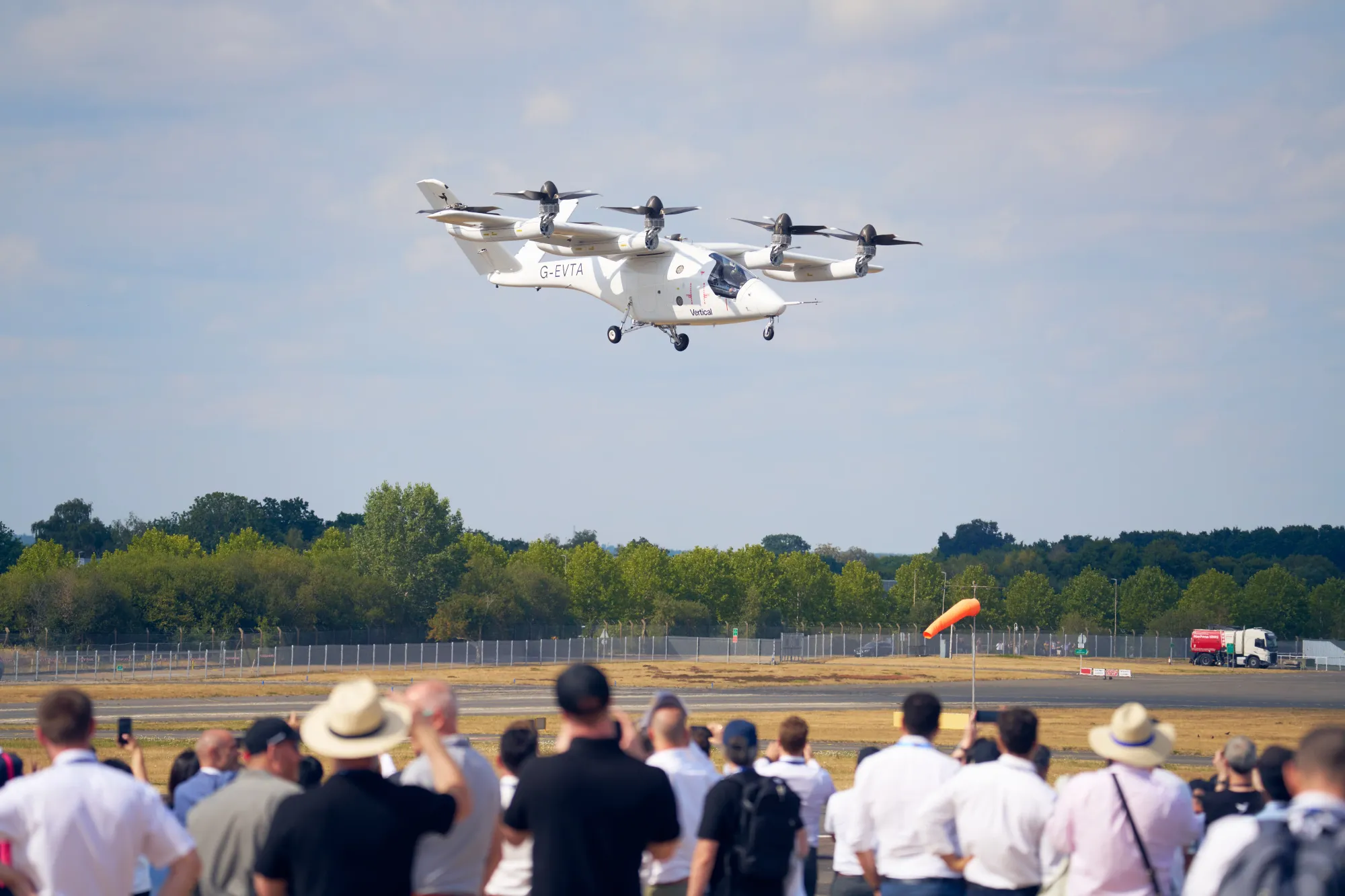
Vertical Aerospace (NYSE: EVTL) has reached several critical milestones in its transition toward commercial electric aviation following a series of demonstrations and strategic announcements at the Farnborough International Airshow. The company successfully completed the first public electric vertical take-off and landing (eVTOL) transition flight, demonstrating the aircraft's ability to move from vertical lift to wing-borne flight without a runway. Beyond flight testing, the company is securing essential industrial and governmental support to build the necessary infrastructure for production. These developments, ranging from UK government discussions to new defense interest, signal a shift from theoretical technology to the practical execution of manufacturing, charging infrastructure, and airspace integration required for the future of electric flight.
Vertical Aerospace Transition Flights and Manufacturing Plans
The week at Farnborough was defined by the successful execution of historic public eVTOL transition flight demonstrations. These flights showcased the aircraft's operational capability in real-world environments, specifically its ability to transition between vertical and horizontal flight modes. This technical milestone is a core component of Vertical's structured flight-test and design-approval program, which utilizes piloted full-scale prototypes to de-risk the path toward achieving Type Certification for its Valo aircraft by 2029.
To support this timeline, Vertical is moving toward industrialization through advanced discussions with the UK Government. The company is seeking a support package of up to £10 million ($13.5 million) to anchor its first full-scale production facilities within the UK. This manufacturing strategy is designed to facilitate a scale-up as the company moves from testing toward entry into service. Furthermore, Vertical has signed a Memorandum of Understanding with UK Export Finance to explore customer financing and export support as it targets international markets. The company is also investing in UK-based battery facilities to ensure the supply chain can meet future production demands. These steps represent a coordinated effort to align technical flight milestones with the physical industrial capacity required for commercial-scale electric aviation deployment.
Charging Infrastructure and Global Airspace Integration
Vertical Aerospace is actively addressing the infrastructure and regulatory requirements necessary for electric aviation through several high-level partnerships. A significant component of this effort is the £3.4 million UK Government-backed ECLiPSE programme, led by Vertical, which focuses on developing next-generation charging and thermal management technologies. This initiative is critical for establishing the specialized power infrastructure required to support electric aircraft operations.
On the regulatory front, Vertical has joined Honeywell Aerospace-led Project VERTI-GO, a major European initiative aimed at integrating eVTOL aircraft into shared European airspace. This project serves as a regional equivalent to the FAA's eVTOL Integration Pilot Program. The company is also expanding its global footprint through strategic regulatory collaborations, including work with Saudi Arabia's General Authority of Civil Aviation (GACA) and a Memorandum of Understanding with Cluster2 Airports Company. Additionally, the company is exploring defense applications through a partnership with Near Earth Autonomy, following confirmed interest from the UK Ministry of Defence in hybrid-electric and autonomous capabilities. These ecosystem-building activities, including new customer agreements with Sigma Air Mobility and VIC Properties, suggest a multi-front approach to overcoming the technical, regulatory, and infrastructural barriers to commercial electric flight.
Key Takeaways
- Vertical Aerospace completed the first public eVTOL transition flight demonstration at the Farnborough International Airshow.
- The company is in advanced discussions with the UK Government for up to £10 million ($13.5 million) to establish full-scale production facilities.
- A £3.4 million UK Government-backed ECLiSE programme is being led by Vertical to develop next-generation charging and thermal management technologies.
EnergyInsyte's Take
In our view, Vertical Aerospace’s recent activities at Farnborough signal a pivot from pure aerospace engineering toward the complex reality of industrial and energy infrastructure. While the successful transition flight signals the aircraft's aerodynamic viability, the true hurdle for electric aviation lies in the "ecosystem" mentioned by CEO Stuart Simpson. The focus on the £3.4 million ECLiPSE programme for charging technologies and the pursuit of UK manufacturing grants demonstrates that Vertical recognizes that flight capability is secondary to energy availability and production scale. By engaging with the Ministry of Defence and international aviation authorities like GACA, the company is attempting to de-risk the regulatory and dual-use pathways simultaneously. This integrated approach—combining flight testing, specialized charging R&D, and manufacturing localization—is a necessary strategy for any player attempting to move electric aviation from a prototype phase into a reliable, capital-intensive commercial industry.
Source: https://www.businesswire.com/